
Math fact fluency
Why a Ten Frame Beats a Number Line for First Grade Addition
Home › Guides › Math fact fluency › Why a Ten Frame Teaches First Grade Addition Better Than a Number Line
Math fact fluency
First graders who count on a number line count ones. First graders who work on a double ten frame watch the ten fill up. That is the difference, and it decides whether 8 + 5 stays a finger problem, or becomes a strategy the child can name.
The question that started this page
A first-grade teacher on TPT wrote this to the author of a within-20 word-problem pack she almost bought:
"Please make these with number paths! I would purchase, but number lines aren't developmentally appropriate for first grade!" — H B., 03/02/2021
That is not a complaint about number lines in general. It is a specific complaint about the stage — the second half of first grade, when children are supposed to move from counting to strategy, and the practice page they are handed keeps pulling them back to counting ones. A number line, printed and used the standard way, asks a child to make a jump. A number path asks the same, only with the boxes drawn in. A ten frame does something else entirely: it shows the ten filling up.
We built F019 — Addition and Subtraction Within 20 around that difference. Below is what a double ten frame lets a first grader see, page by page, that a number line does not.
What a number line assumes a first grader has already built
A number line is a picture of a fact you already own. To use one, the child has to accept three things at once: that the space between two marks is a unit, that a jump of five means five equal spaces, and that the answer is the mark you land on. In late kindergarten this is a stretch. In the second half of first grade it is often shaky enough that a child does what looks safer: counts the tick marks, one at a time, with a finger.
Counting the tick marks is not using the number line. It is counting ones on a page that happens to have a number line on it. The strategy the curriculum names — "count on from the bigger number" — does not fire.
What a ten frame lets a first grader watch happen
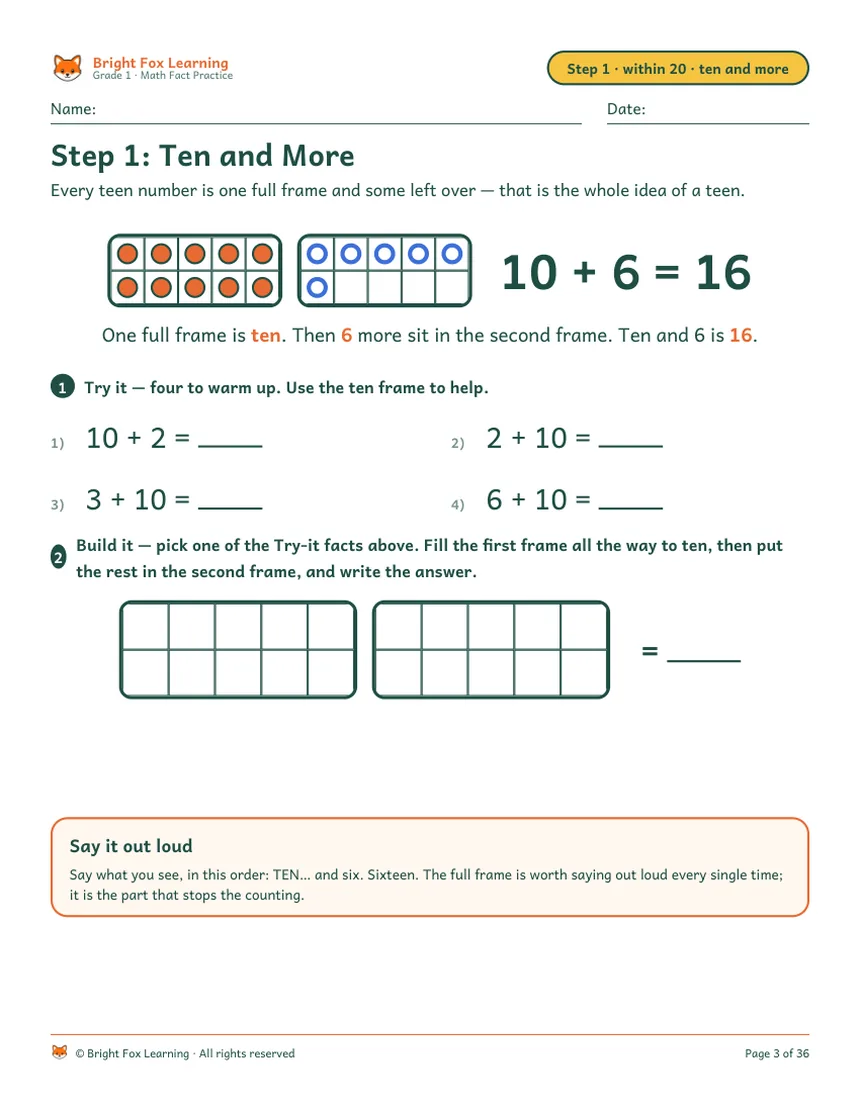
A ten frame is not a picture of a fact. It is the shape of ten. Ten cells in two rows of five. When a child places counters into a ten frame, the "ten" is the first thing that finishes; the ones are what falls into the second row. If you print a second frame next to the first, the boundary between the two frames is the ten. A child does not have to accept the boundary — they can see it.
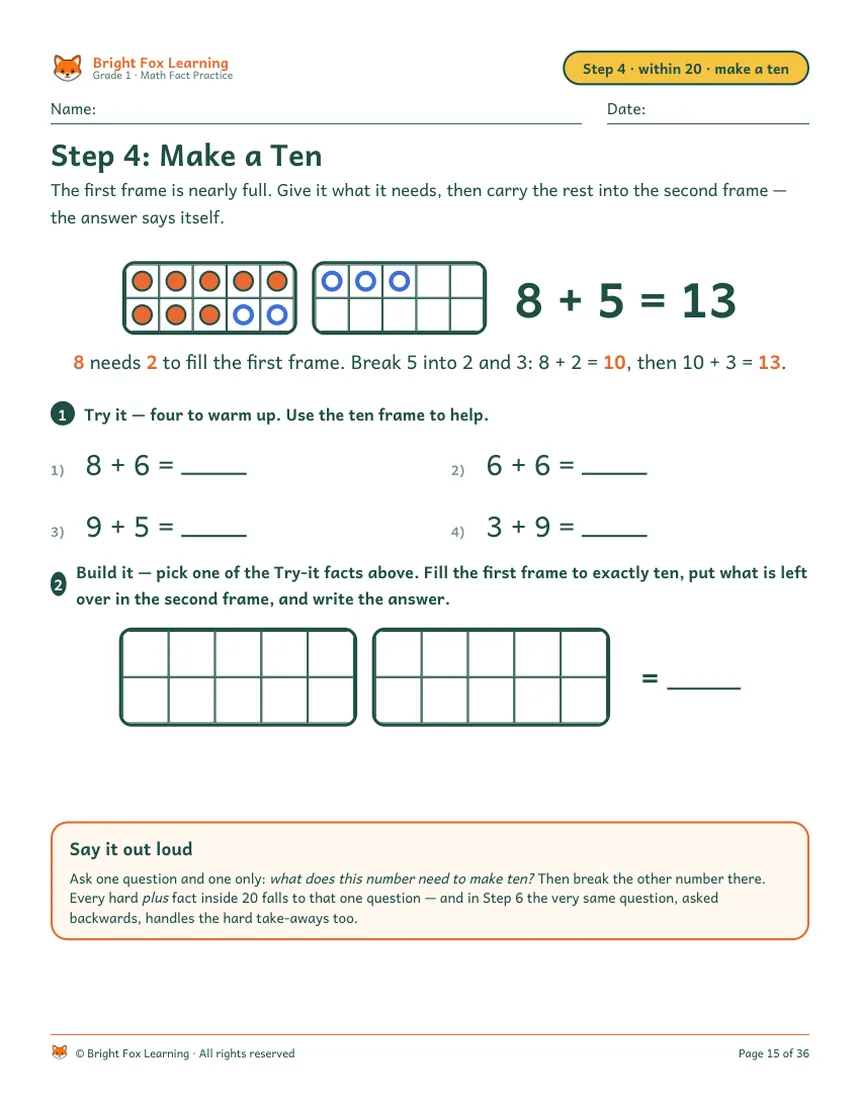
That single visual — the boundary — is what turns a hard fact like 8 + 5 into a strategy instead of a count. The eight fills eight of the ten cells in the first frame; the five cannot all fit there, so two of them finish the first frame and three land in the second. The answer is not calculated. It is what is on the page.
Step 1: Ten and More — the frame before the crossing
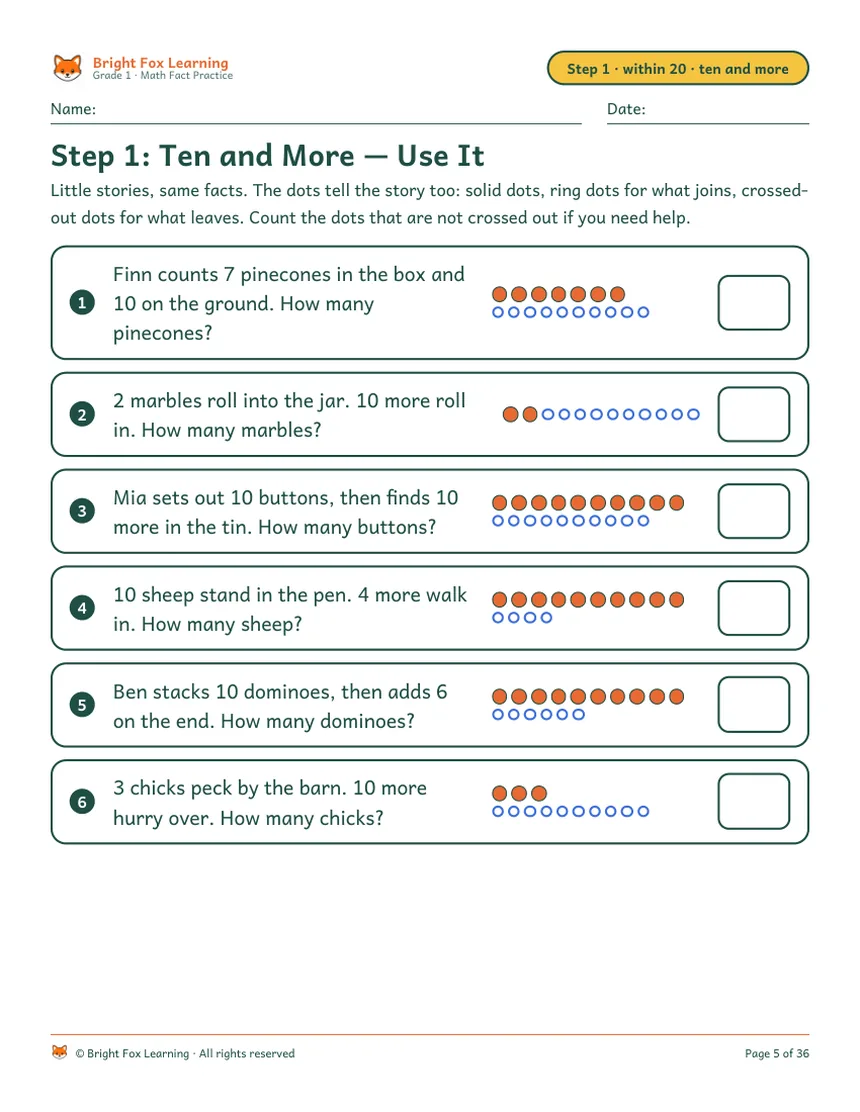
Before a child can bridge over ten, they have to see ten as a chunk that is already whole. Step 1 of the set does one thing: little stories that begin with ten and add a few, or begin with a few and add ten. Every story has a row of dots next to it — solid dots for what is there, ring dots for what joins. Ten dots always fill a whole row, so the child never counts past ten to find ten. They see it.
We wrote six of these stories to a page, on purpose. Not twenty. A first grader who is asked to look at twenty problems on one page will start solving in their head, and Step 1 is not about answers — it is about the shape being installed. Six stories are enough for the shape.
Step 2: Doubles to 20 — the second warm chunk
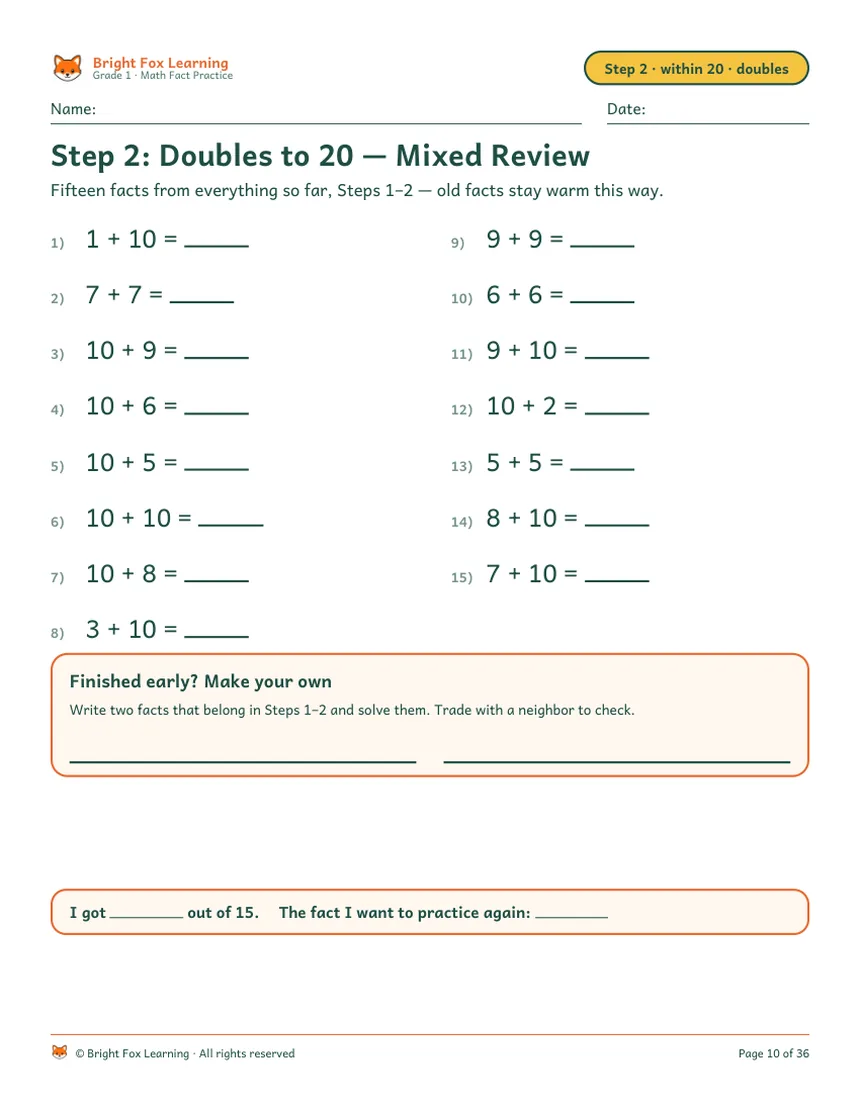
Doubles are the second set of facts most first graders already own — 3 + 3, 4 + 4, 5 + 5. Step 2 mixes them with the "ten and more" facts from Step 1, on one page, so the child rehearses two warm chunks side by side before we ask them to bridge anything.
The mix is not accidental. If we practise doubles alone, a child treats the page as a doubles page and stops thinking. Mixing them with 10 + 5 and 3 + 10 makes the child read each fact and decide which chunk it belongs to. That is the smallest possible piece of the strategy work that comes later.
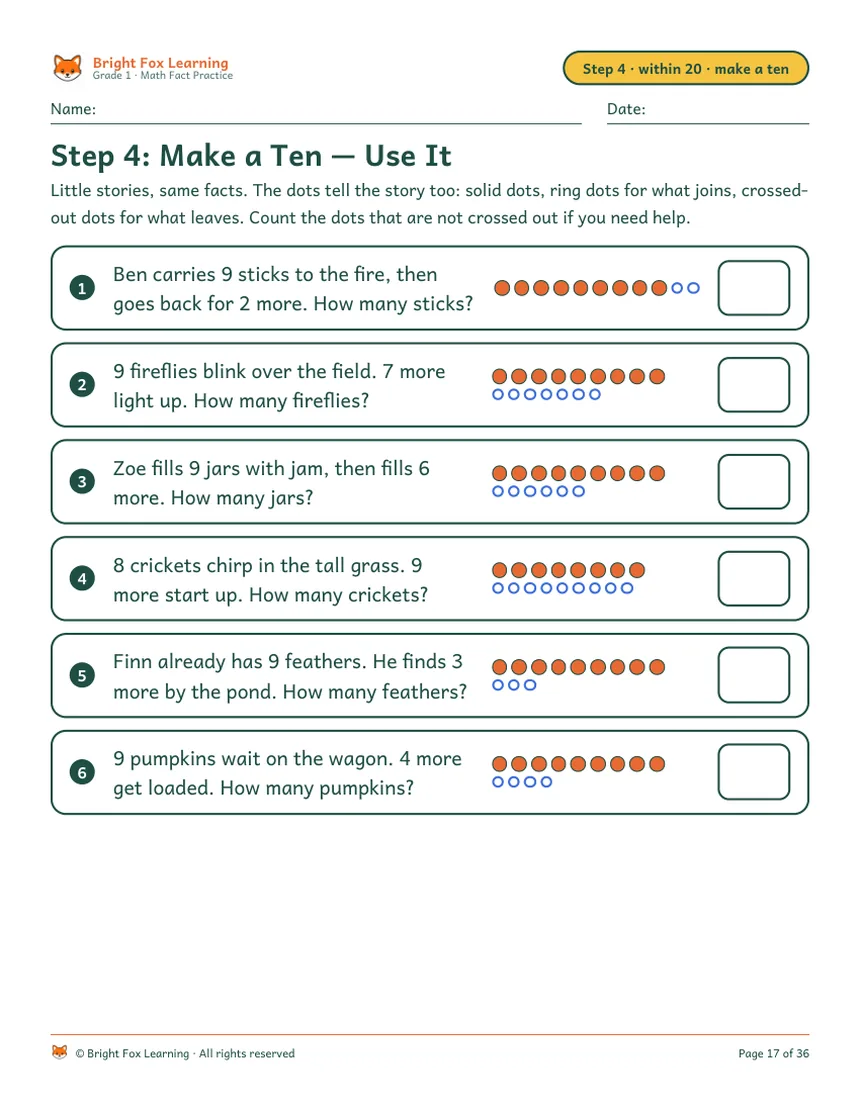
Step 4: Make a Ten — one question, printed on the page
Step 4 is the whole reason the set exists. It is where 8 + 5 stops being a hard fact and becomes a two-step move: fill the first frame to ten, put the rest in the second frame, read the answer.
The teaching block on Step 4 says one thing, in a peach box under the double frame:
Say it out loud. Ask one question and one only: what does this number need to make ten? Then break the other number there. Every hard plus fact inside 20 falls to that one question — and in Step 6 the very same question, asked backwards, handles the hard take-aways too.
That is the whole strategy. The word "strategy" is worth thirty dollars in a professional development book; on this page it is one printed question. A child can be asked it aloud, and after two or three passes they ask it of themselves. When they do, they have crossed the bridge — not "learned the make-a-ten strategy" as a checkbox, but installed the one habit that makes it work.
The "Try it" row underneath gives them four warm facts to run the move on, and the "Build it" panel underneath that gives them a blank double frame to draw the move themselves.
Step 5: Take Away Inside a Teen — the mirror move
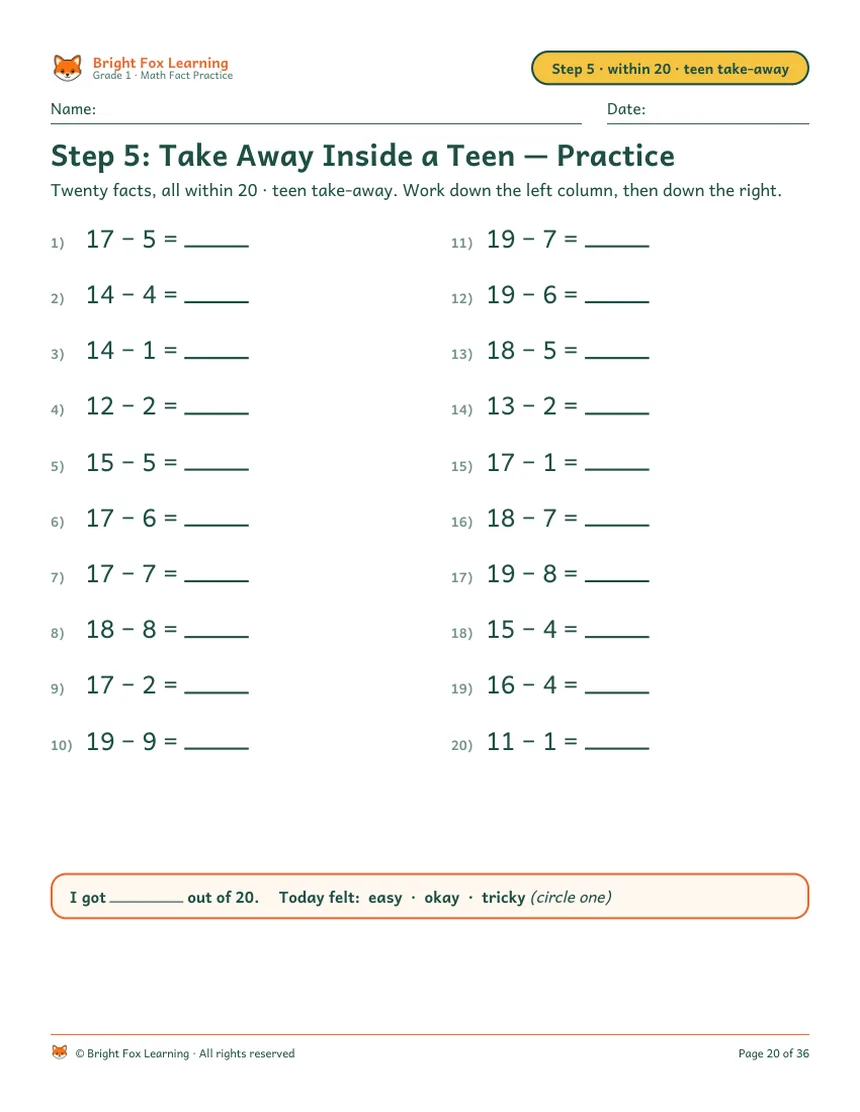
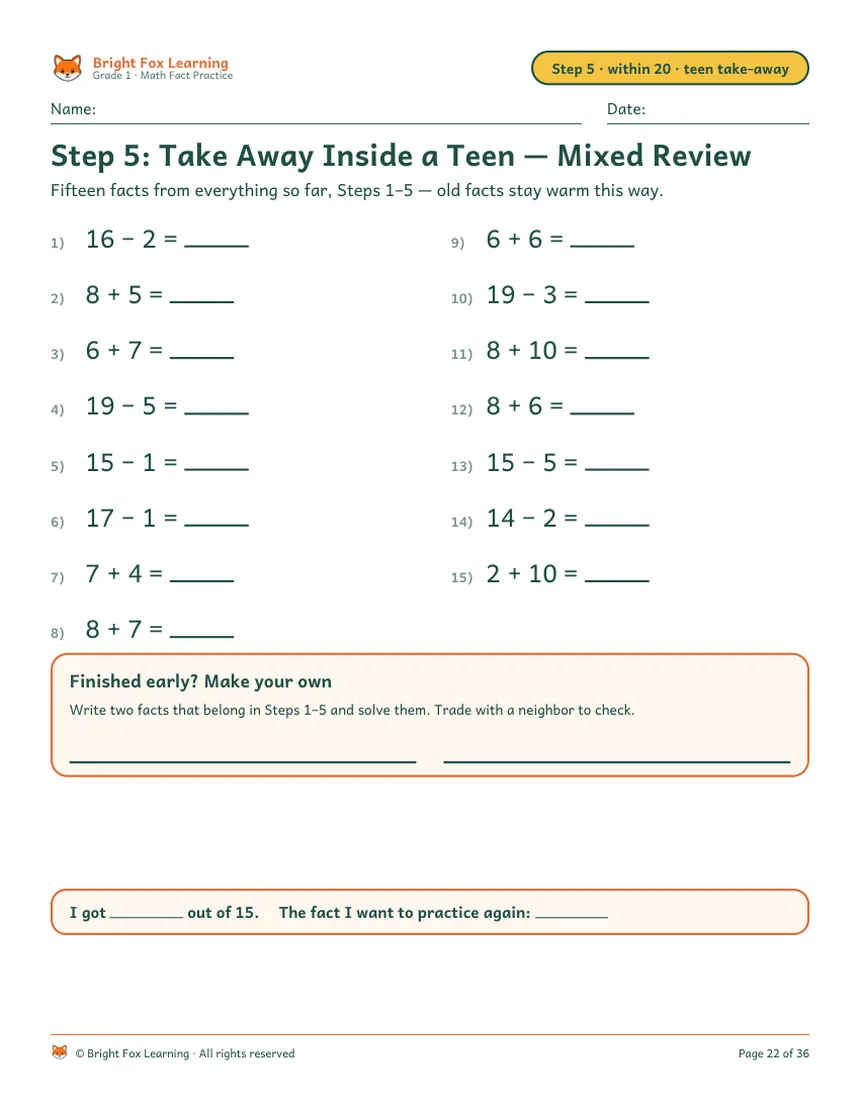
Between the plus half and the minus half of the bridge, there is one intermediate step: take-aways that never leave the teen. 15 − 4, 17 − 5, 13 − 2. These are the subtraction analogue of "ten and more" — they keep the ten intact and only touch the ones.
We put them here on purpose. If a child sees 14 − 9 before they see 15 − 4, subtraction feels like a whole new subject. If they see 15 − 4 first, they see that the ten sits still and the ones do the moving. That prepares them to hear the next question.
Step 6: Cross Back Over Ten — the same question, backwards
Step 6 is where subtraction over ten stops being scary. Same double frame, same question, only running backwards: what does this number need, subtracted, to get back to ten? Once the child has the "make a ten" question in their bones from Step 4, this one lands in the same slot.
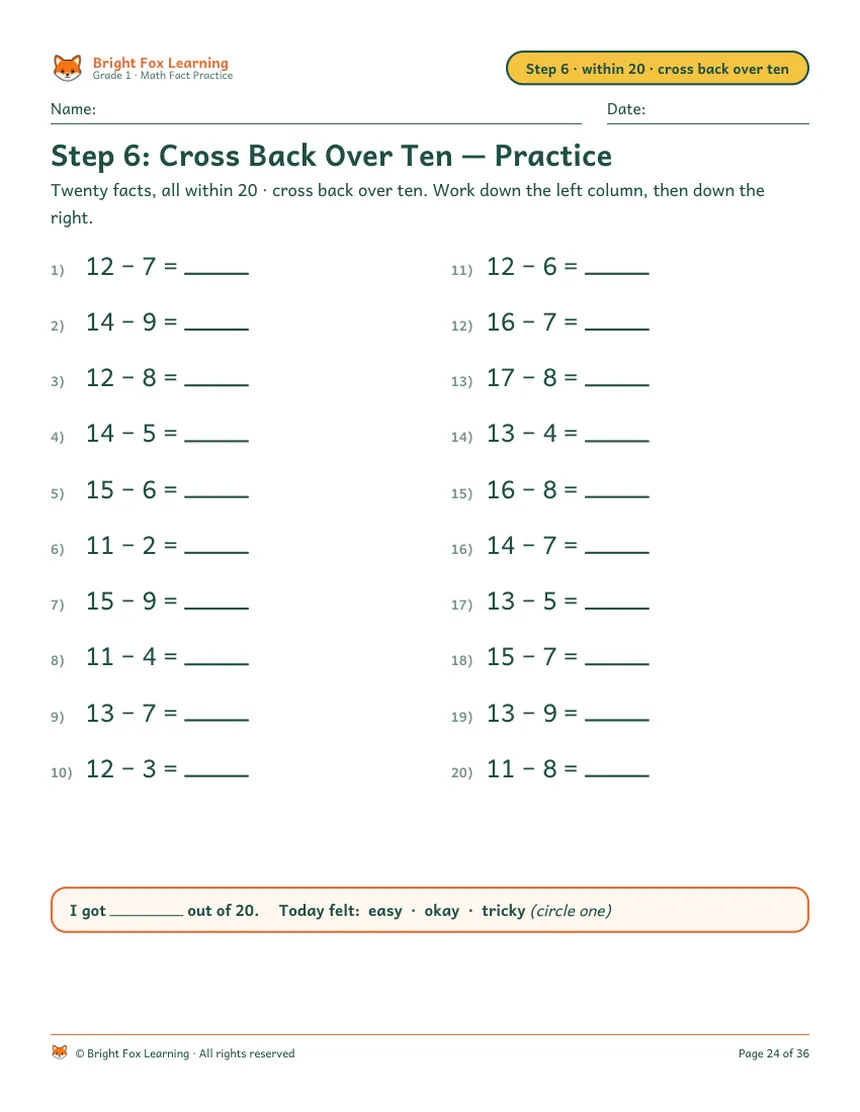
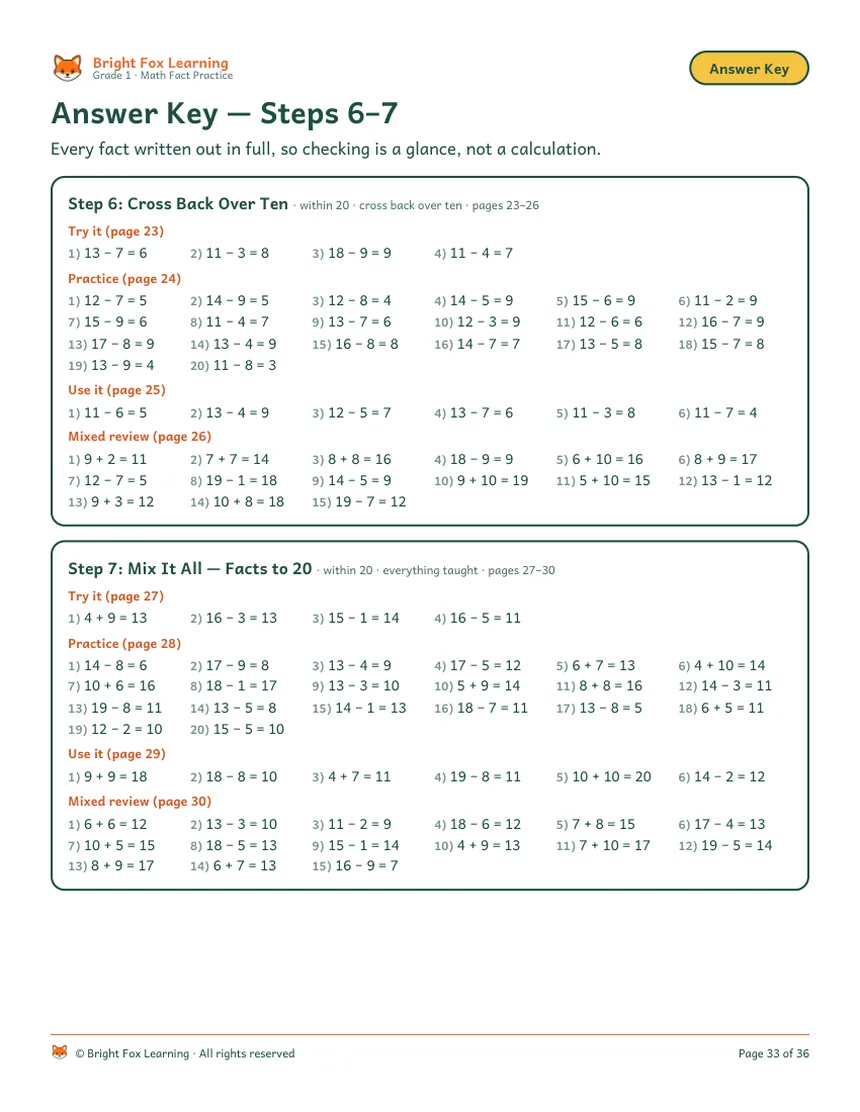
The practice page for Step 6 has twenty facts. All of them cross back over ten. None of them are 15 − 4 (which would sit inside the teen and let the child cheat with counting). The set of facts is chosen by the same machine that writes them: a page labelled "cross back over ten" that lets one non-crossing fact through would fail the build before it printed.
That is the invisible bit that keeps the strategy honest. A make-a-ten page holding a fact that never crosses the ten, or a doubles page slipping in a non-double, is not a wrong page in the small sense — it is a page that lets the child skip the strategy. The independent checker refuses to let that happen.
Step 7: Mix It All — where the strategies become choice
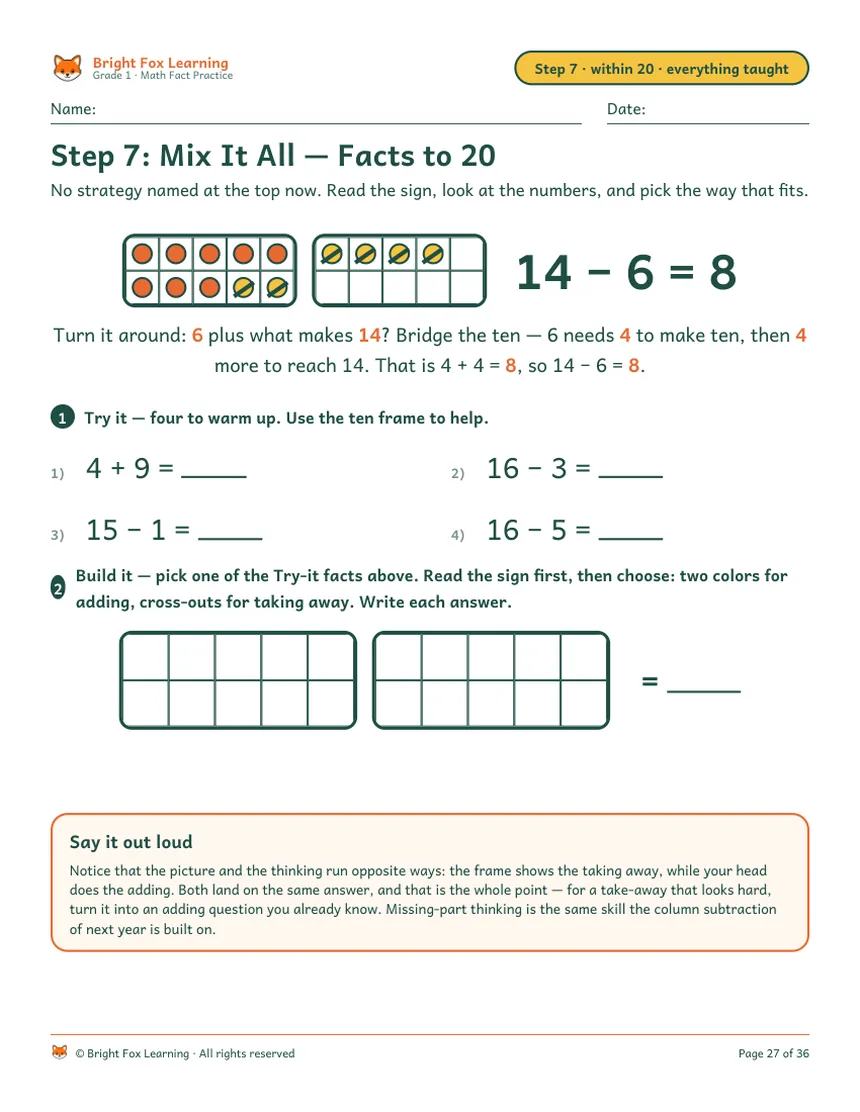
After six steps that each drilled one move, Step 7 stops sorting the facts. Fifteen facts to a page, drawn from everything taught, in no strategy order. The child looks at 4 + 9 and thinks make a ten. Looks at 6 + 6 and thinks double. Looks at 10 + 5 and thinks ten and more — no thinking, actually, they just write 15. That switching is the fluency you were aiming at all along.
What it looks like in your first-grade routine
Twelve minutes with a small group. One step per session. Rug work first — the teaching page fits on a document camera and the "say it out loud" line runs the whole rug conversation. Then the practice page goes to the child's clipboard for the remaining eight minutes.
The step label at the top-right corner (Step 4 · within 20 · make a ten) is a reminder to you. A first-grader who does not know what strategy the page is drilling is not going to argue with the header — but you will remember to ask the one question that makes the page work.
The answer key gives you every fact, written out in full, grouped by step. Checking is a glance, not a calculation. Which matters at 3:15 on a Thursday when your grade-level meeting starts at 3:30.
A note on progress: the child marks the page
At the bottom of each practice page there is a row: I got ___ out of 20. Today felt: easy · okay · tricky (circle one). This is not decorative. It is the smallest possible piece of the child's own progress log, and it does something the number score cannot: it separates "the child got fifteen right and felt fine" from "the child got fifteen right and felt tricky the whole way".
We keep this row for the same reason we chose the ten frame over the number line: it puts the marking of progress on the page the child is already working on, instead of asking the teacher to translate a score into a decision after the fact. If a child scores twenty out of twenty and circles tricky three days in a row, that is a decision — you back off a step. The dash on the page is the record.
The set behind this guide
The set that puts these ideas on paper is F019 — Addition and Subtraction Within 20: 36 pages, 7 named steps, 315 facts, a double ten frame on every teaching page, and one printed strategy label per page that the answer-key checker reads and enforces. It is the bridge above F018 — Addition and Subtraction Within 10, which is the fluency floor most first graders are standing on when they arrive in January.
See F019 — Addition and Subtraction Within 20 →
Answers to the questions we hear most
Why not just use a number line?
Because the standard number line, printed for a first grader in the second half of the year, gets counted rather than jumped on. The child treats each tick as a one, and the strategy the curriculum names never fires. A double ten frame does not have ticks. It has a boundary at ten, which is the whole reason for the frame.
Can I start with Step 4 or do we have to walk Steps 1–3?
You can, if the group already owns the doubles and the "ten and more" facts by heart. If they don't, Step 4 will feel like a wall. Steps 1–3 exist to install the two warm chunks that the make-a-ten move stands on. In our own testing rooms, three sessions of Steps 1–2 saved two weeks of make-a-ten confusion.
How do you know a child is ready to move on from a step?
Two clean practice pages in a row, and the "Today felt" row circled okay or easy. If either signal is missing, run one more practice page in the same step. The whole point of naming a step is so you can go back to it.
Is F019 the same as F018 with bigger numbers?
No. F018 is the recall floor within ten, using a single ten frame. F019 is the bridge above it, using a double ten frame, and every practice fact in F019 reaches ten or beyond (with one honest exception: 5 + 5 appears in Step 4 because it is the neat neighbour of the make-a-ten move). If a first grader owns F018 cold, F019 is the natural next set. If they are still counting to answer 6 + 3, keep them on F018 for now.
Can I print just the pages I need?
Yes. Each step is a small print job: a teaching page, one or two practice pages, and the corresponding answer key page. The step label at the top-right corner means a printed loose page never becomes an orphan on a teacher's desk.