
Decodable passages
How to Run One Decodable Passage in a 12-Minute Small Group
You get twelve minutes with each group. Here is the order that fits: one minute on the sounds line, three on the word list, six on the passage, two to hear one reader alone. One passage, read three times, for three different jobs — decode, then meaning, then a question that cannot be copied.
- Minute 1 — read the sounds line, the character names and the heart words out loud.
- Minutes 2 to 4 — the fifteen-word list, then three swaps said out loud with no pencil.
- Minutes 5 to 10 — the passage read three times: decode, then meaning, then the four questions.
- Minutes 11 and 12 — one child reads alone while the others finish, then mark the progress chart.
Twelve minutes is not a complaint. It is the actual shape of the small-group phonics block in most rooms, and it is the number we build pages around. What follows is one routine for one passage, minute by minute, and the three places it usually falls apart.
Minute 1 — read the sounds line, not the title
A passage that says decodable on the cover tells you nothing about the four children in front of you. What tells you something is the line printed underneath the story.
On every passage in our sets that line reads like this:
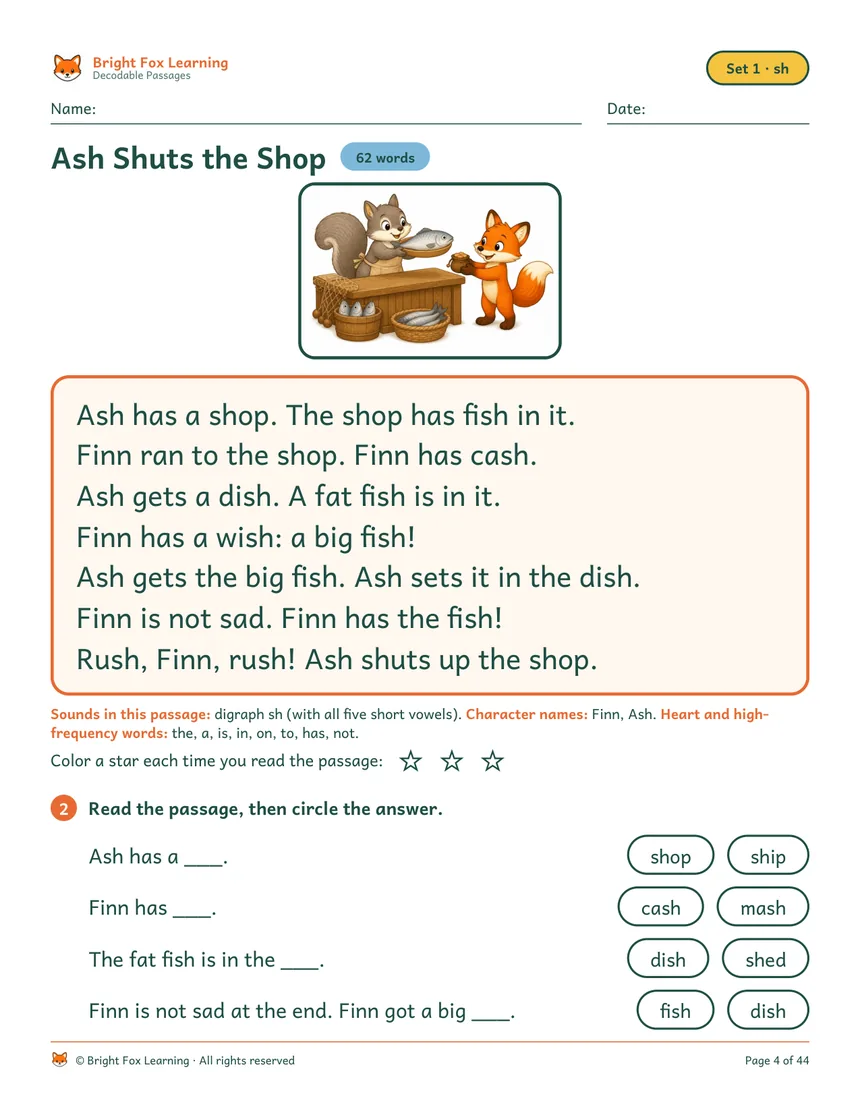
Sounds in this passage: digraph sh (with all five short vowels). Character names: Finn, Ash. Heart and high-frequency words: the, a, is, in, on, to, has, not.
Spend the first sixty seconds there, out loud. Say the sound. Point at the character names, because a name is not decodable — a child who has never met Ash will stall in line one and spend the rest of the passage catching up rather than reading. Then read the eight heart words across.
That is one sound, two names and eight words. It fits in a minute, and it is the minute that pays for the other eleven. Almost everything that goes wrong later in a small group goes wrong because a child hit something on the page that nobody had named for them first.
Minutes 2 to 4 — fifteen words, and three of them change out loud
The word work page of each set holds fifteen words. The instruction printed for the child is read each word, tap a dot for every sound you hear, then say the whole word — so ship gets three dots, not four. That is the whole point of the dots: the child counts sounds, not letters, and two letters making one sound is exactly where the counting breaks.
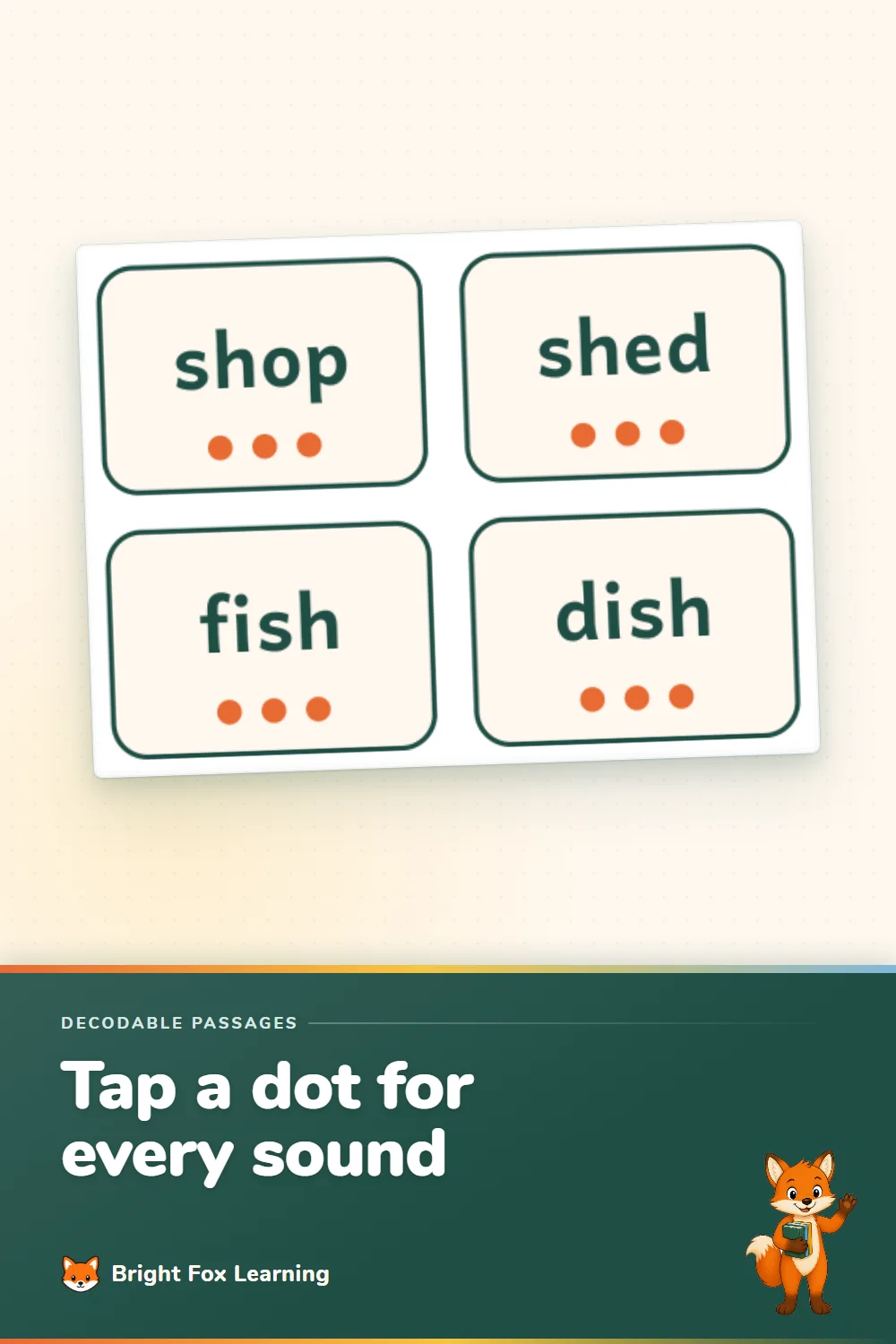
Where the pattern sits inside those fifteen words is not the same from one set to the next, and it is worth saying out loud. In the sh set, six words start with the sound and nine end with it. In the ck set and the ng set, all fifteen end with it, because that is where those spellings live in English. In the wh set, none of them do.
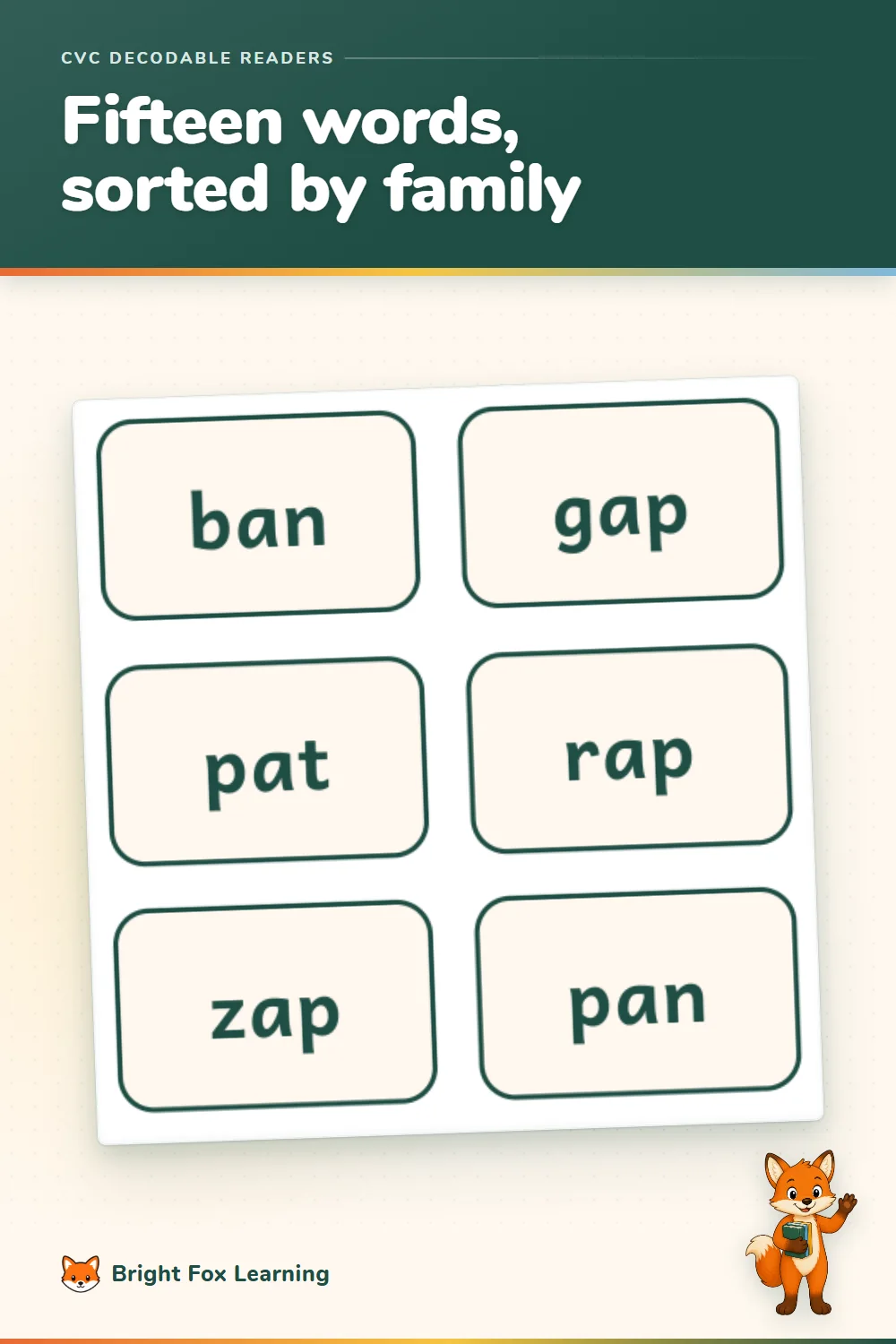
A child who expects the sound at the front of every word will read the ck list wrong for a reason that has nothing to do with the sound itself. That is why each set also carries a sorting page: it asks the child to look at where the pattern sits, at the start of the word or at the end.
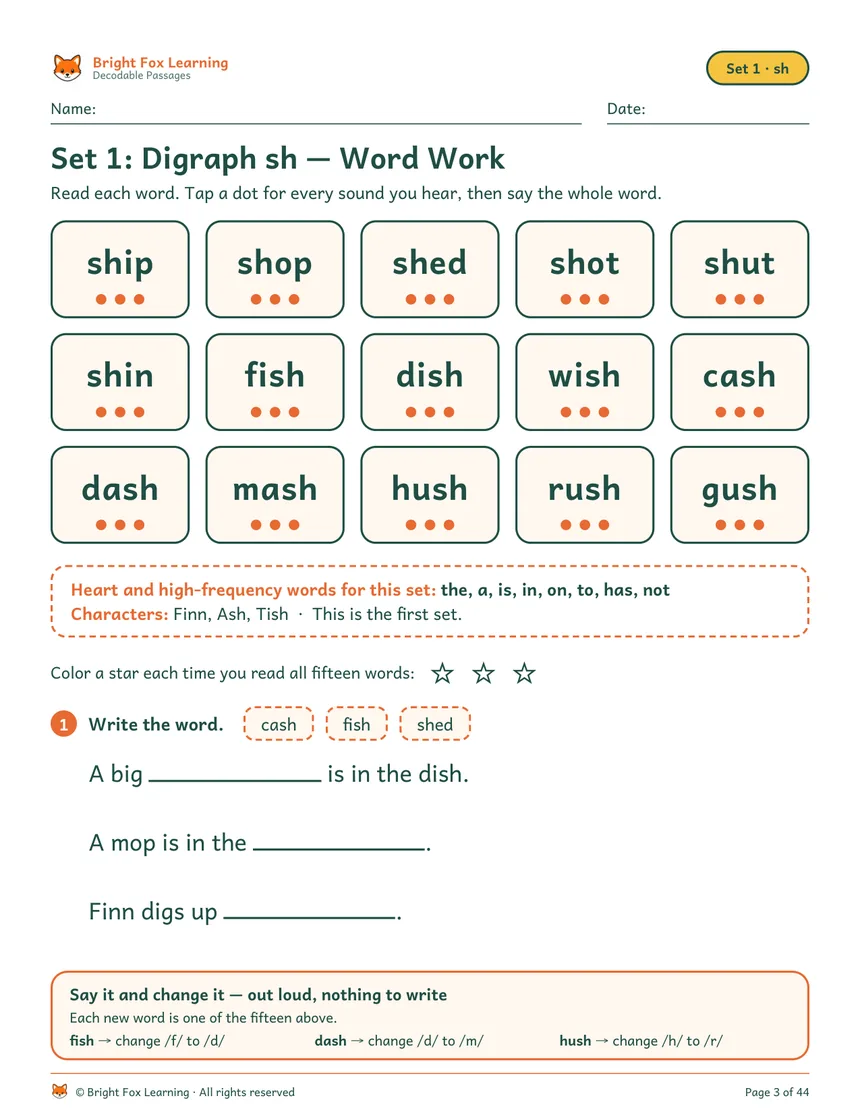
Give this three minutes and keep pencils out of it for the first two. Read down the columns once. Then run the three lines at the bottom of the page, which are printed as say it and change it — out loud, nothing to write:
- fish → change /f/ to /d/
- dash → change /d/ to /m/
- hush → change /h/ to /r/
Three swaps, thirty seconds, no paper. Every word the swap produces is already one of the fifteen above, so nobody is guessing at a word they have not seen. If a child cannot do these three, the passage will not hold, and you have found that out in minute four instead of minute ten.
Minutes 5 to 10 — one passage, three reads, three jobs
Six minutes is enough for a 55-to-62-word passage read three times, and three reads is what the page is designed for: there are three stars printed at the bottom, and the child colours one each time.
Give each read a different job. Reading the same passage three times is the fluency part of the block: speed and phrasing come from the second and third read, not the first, which is why the page is built for three and not for one.
Read one is for decoding. Nothing else. You are listening for the sound you just taught, and you let the child work. Do not supply words that are in scope — the whole file is built so that they do not have to be supplied.
Read two is for meaning. Slower, in phrases, and this is where you ask what happened, informally, before anything is circled.
Read three is for the questions. Four of them sit on the same page as the passage, in circle-the-answer form, so nobody turns a page and loses the thread.
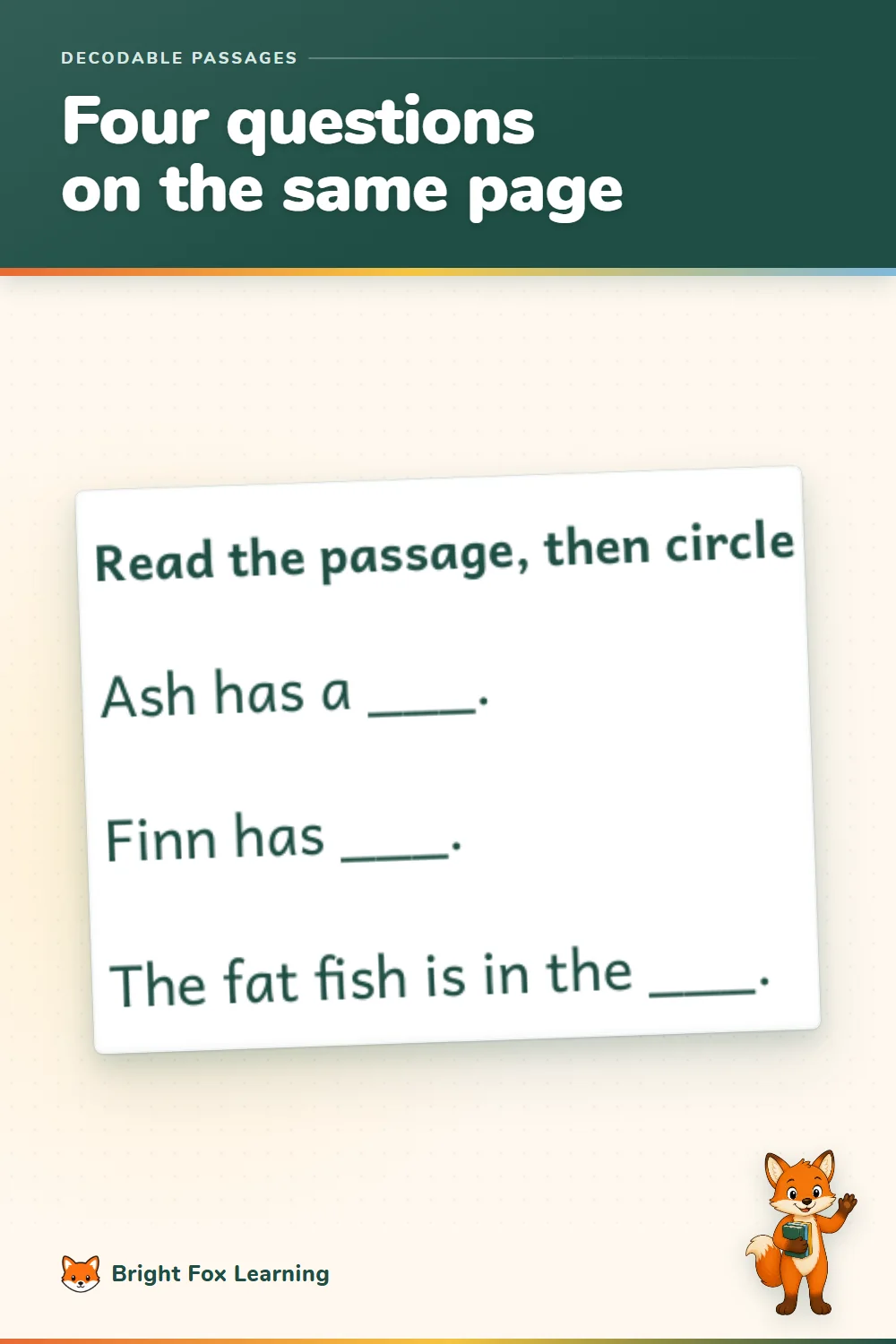
The fourth question is deliberately not like the first three. The first three can be answered from one line. The last one cannot — the answer key calls it the thinking question, because it asks the child to put two parts of the passage together instead of copying one line back. “Finn is not sad at the end. Finn got a big ___.” You have to have read the ending and the wish to answer that.
If you want the version of this that is already assembled — six digraphs, one per set, in the order they are taught — that is the set these pages come from.
See what’s inside F005 →Minutes 11 and 12 — one reader alone, and a mark you can keep
Two minutes, one child, reading the passage alone while the other three colour their third star or start the reprint. You are not testing anyone. You are hearing one voice without the group carrying it, which is the only way to know whether the group read the passage or the strongest reader did.
Then mark the progress chart. There is one row per sound set, and it is the only running record the file asks for. It takes about ten seconds and it is what tells you, three sets later, whether ck ever actually landed.
Where a decodable passage lesson usually goes wrong
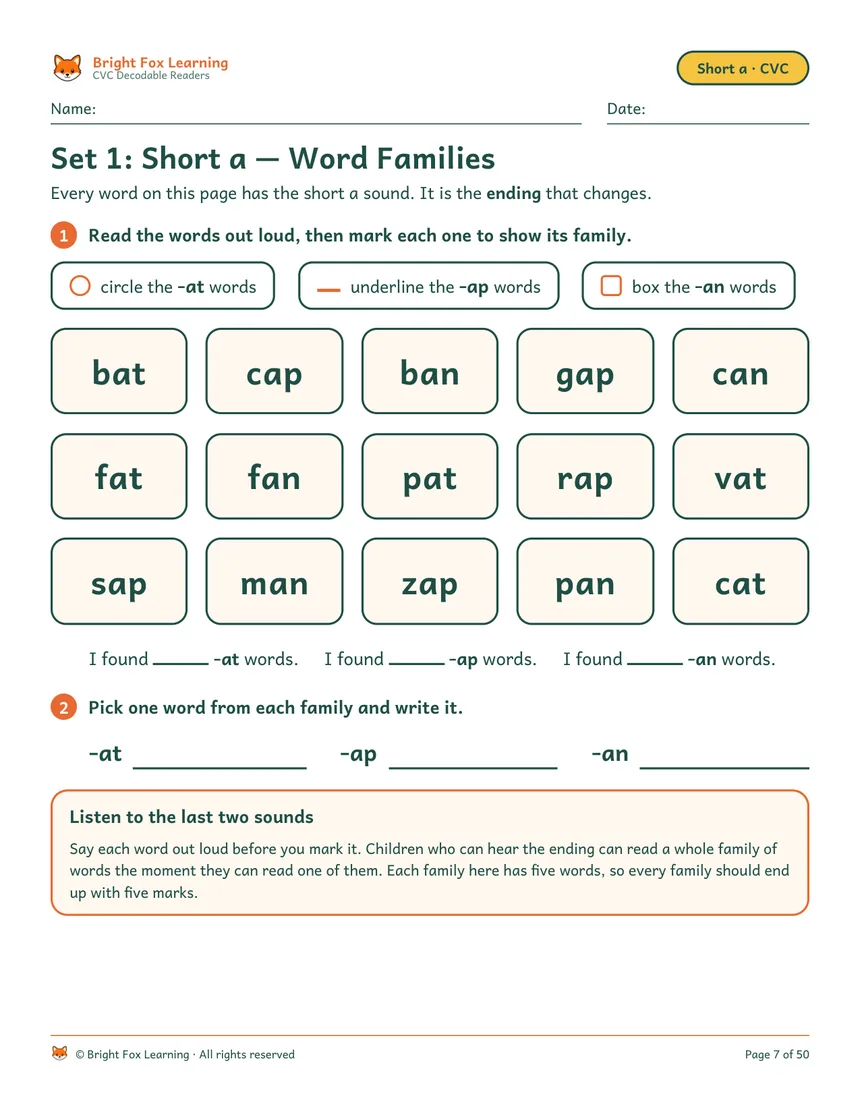
The passage was out of reach before you started. If a group is still working through short vowels, a digraph passage will eat all twelve minutes and produce nothing you can use. The honest move is to go back a step rather than push through — a CVC story with the same six-page shape keeps the routine identical while the content drops to where the group actually is.
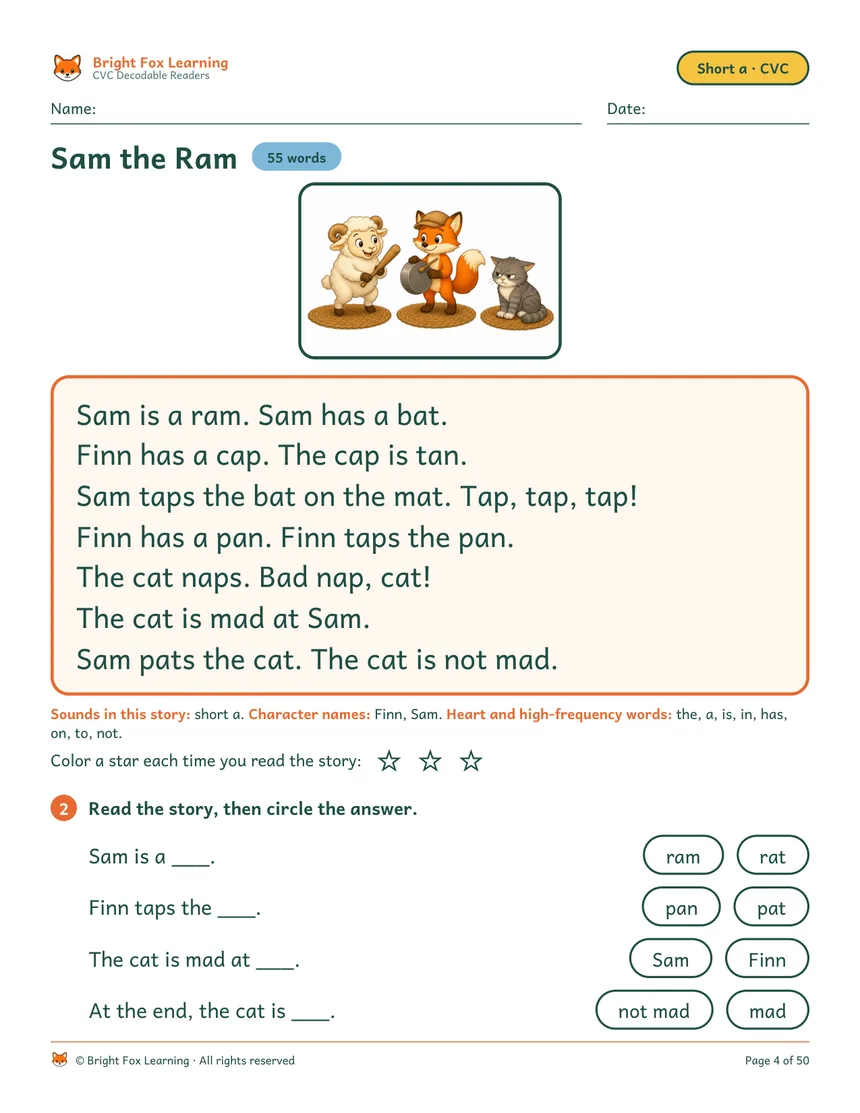
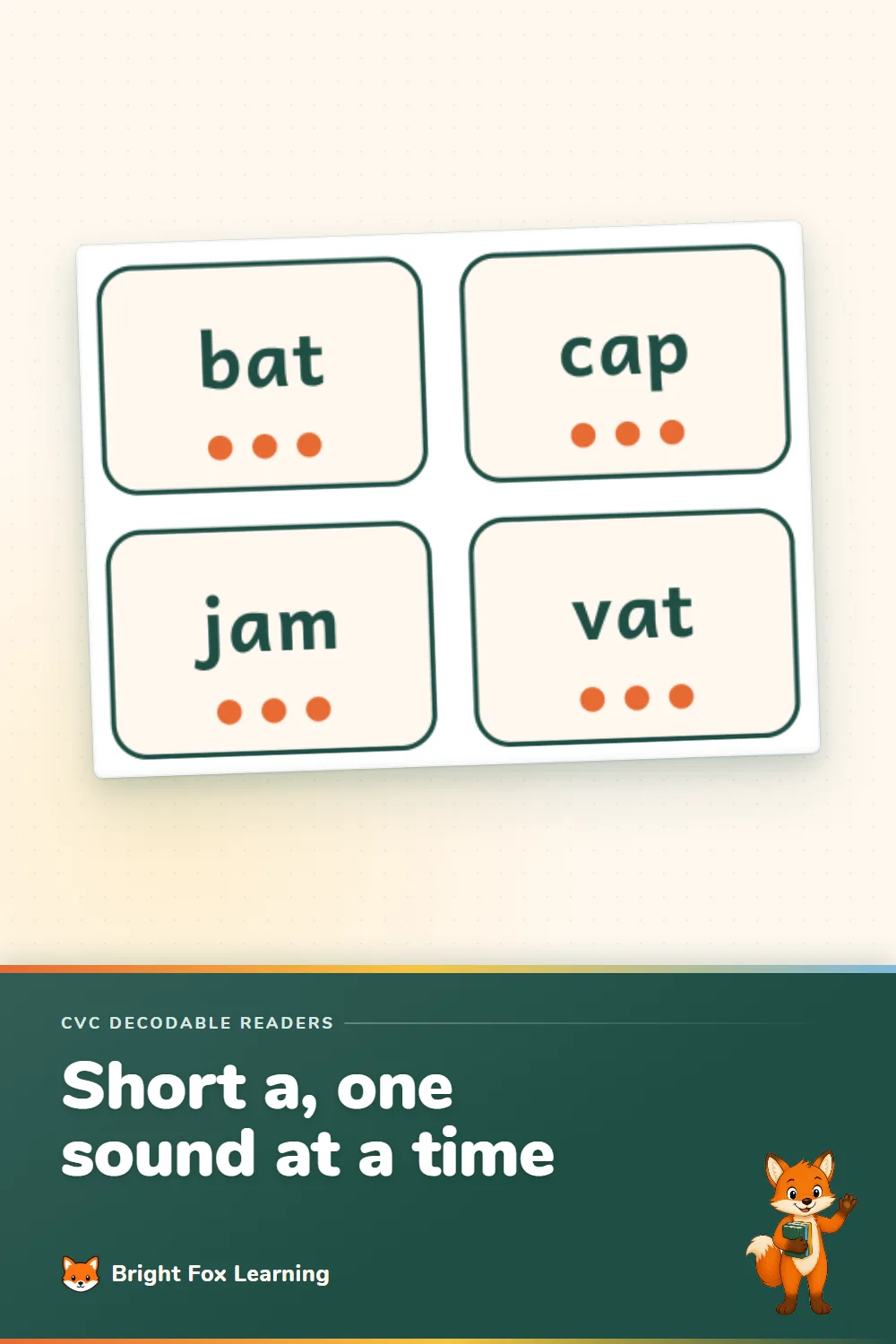
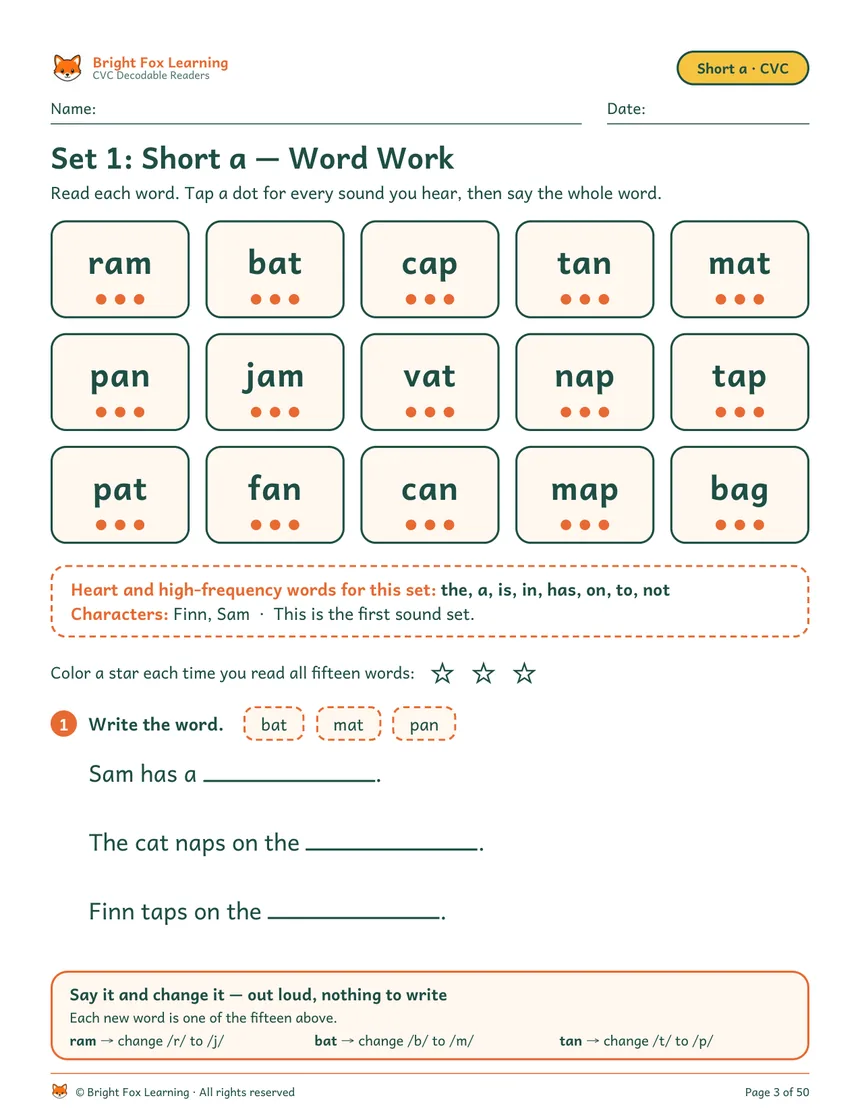
Note that the two word work pages above are the same page, one step apart. That is deliberate: the group drops a level in content and keeps the routine, so the twelve minutes do not have to be re-taught.
See what’s inside F002 →Too many new things arrive at once. A set that hands a group sh, th, ch and ck in the same week is not teaching four sounds; it is asking a child to sort four unknowns while also reading. One new sound per set, with two whole passages before the next one arrives, is why the twelve minutes stay spendable on reading rather than on sorting.
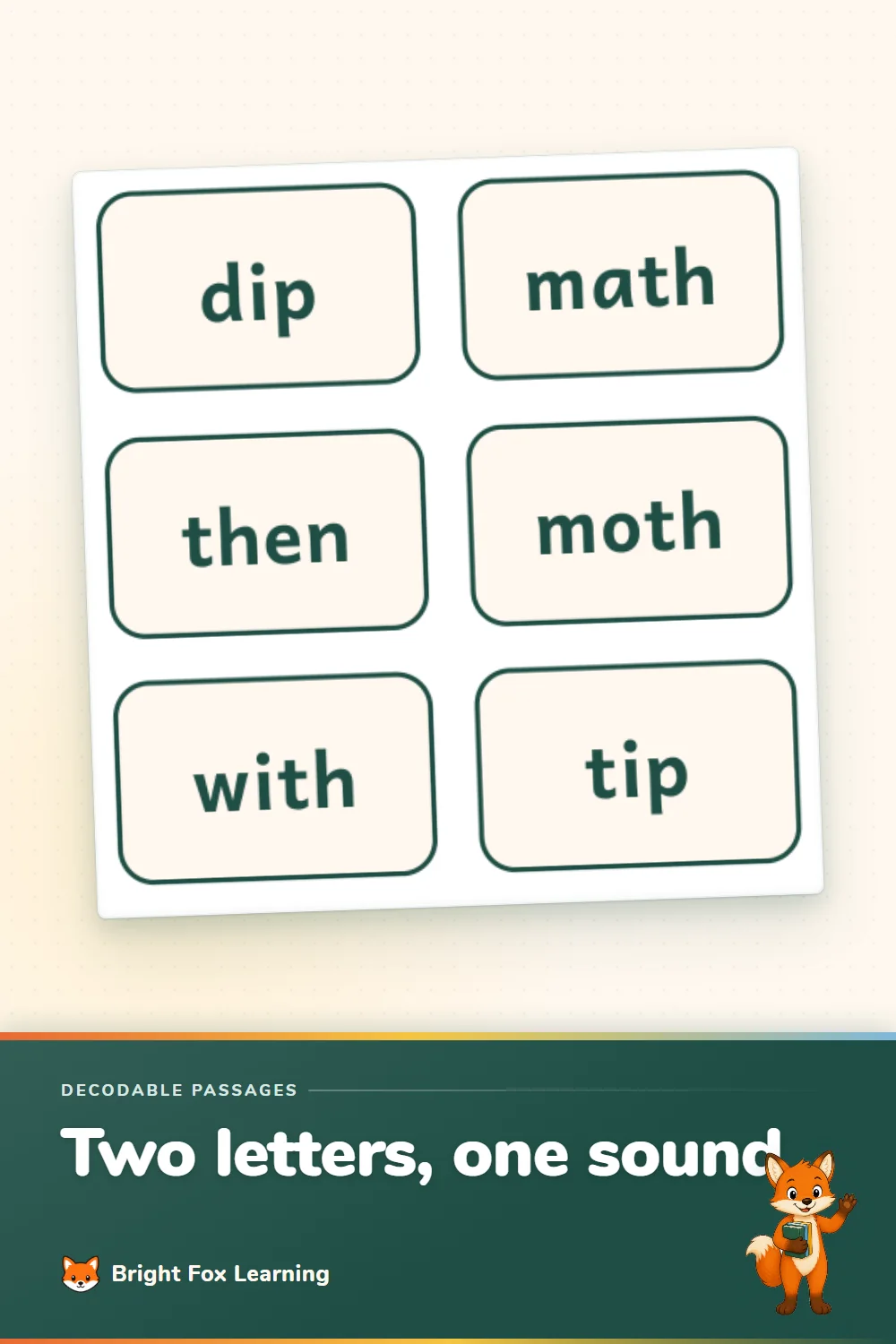
Writing gets folded into the block. It does not fit. The write-it page and the sorting page are good work, but they are day-two and day-three work, or independent work — not something to squeeze between minute ten and minute twelve.
What the same set does on the other days
Each sound set is exactly six pages, in the same order every time: word work, passage one, passage two, write it, sort the words, and an ink-friendly reprint of the first passage. That shape is the reason the routine gets faster — the child learns the sequence once and still knows it six sets later.
One way to spread a set across a week:
- Word work, then the first read of passage one.
- Passage one again, then its four questions.
- Passage two and its questions.
- The write-it page — finish the sentences from the story, then write each of the ten words once, look-say-cover-write-check.
- Sorting, and the ink-friendly reprint goes home.
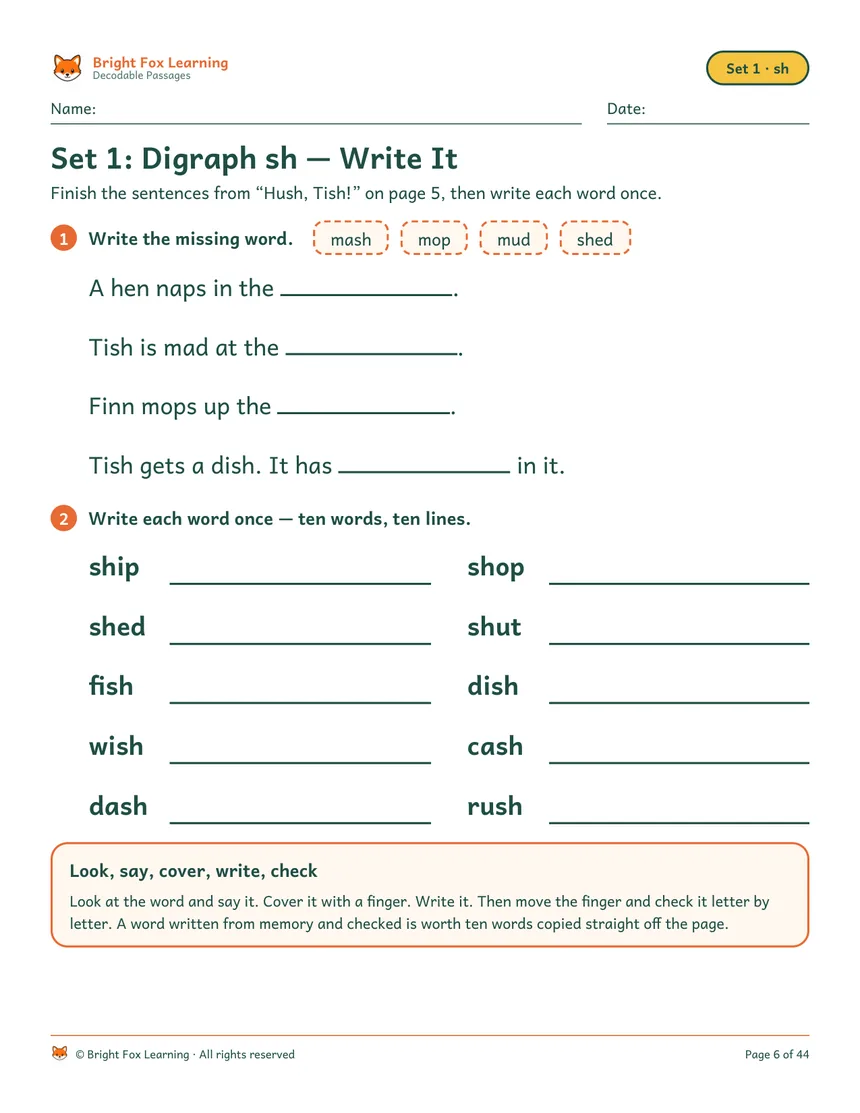
The reprint matters more than it looks. It is the same passage in ink-friendly form, so the copy that goes home is the copy the child already read three times with you — not a new text a parent has to referee.
What is actually in the decodable passage sets
We would rather print the numbers than describe them.
F005 — Decodable Passages with Comprehension Questions · 44 pages · $4.50
- 6 sound sets, six pages each — one digraph per set, in the order sh, th, ch, ck, wh, ng
- 12 decodable passages — two per set, 55 to 62 words, each with its own characters
- 90 word cards with sound dots
- 48 multiple-choice questions and 42 fill-in-the-blank items, with word banks
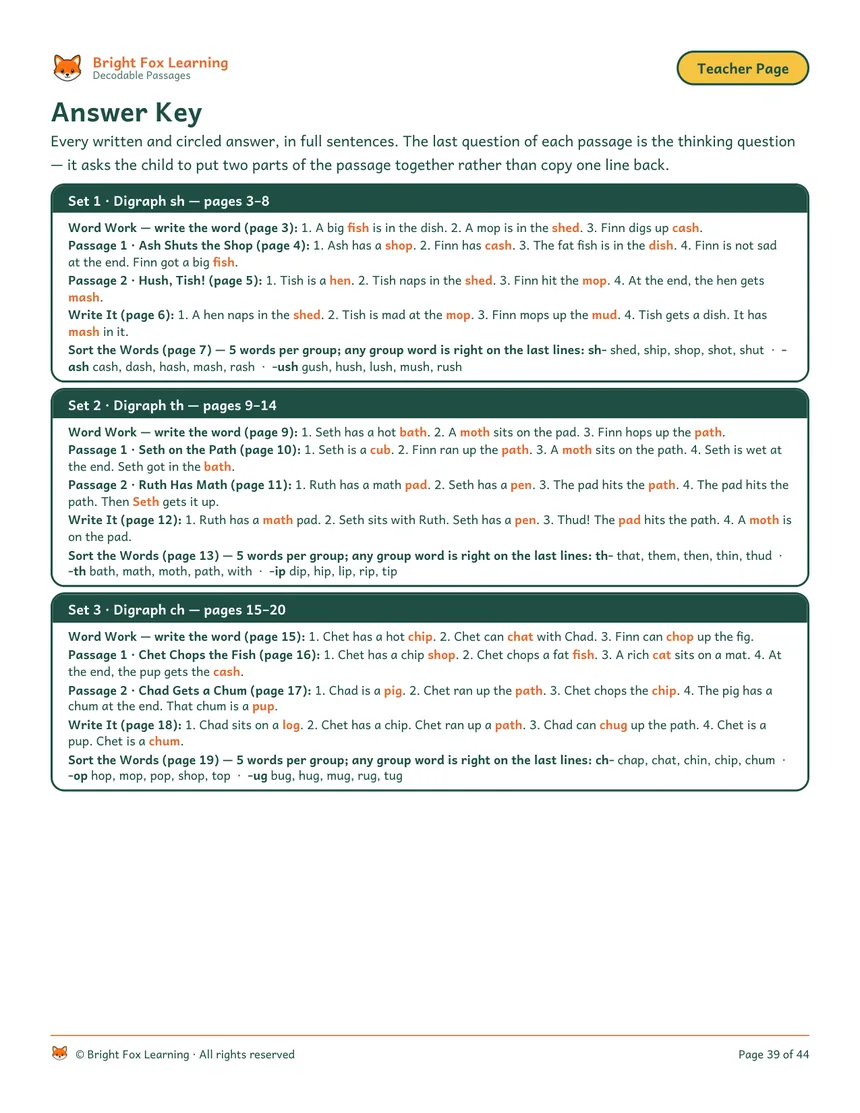
- 90 answers on the key, on two pages
- 6 ink-friendly reprints, a progress chart, an award page and a skills map
F002 — Short Vowel CVC Decodable Readers · 50 pages · $5.50
- 7 sound sets, six pages each — short a and short i each get a second set with new word families
- 14 decodable stories — two per set, 40 to 62 words
- 56 multiple-choice questions and 49 fill-in-the-blank items
- 105 answers on the key
Every word a child has to read in either file is checked against the sounds taught up to that set before the page is printed. No blends, no silent e, no vowel teams, no bossy r where they have not been taught. You can verify that from across the table, because the sounds are printed on the page.
Questions we get
Can I start a group in the middle of the file? Yes. Every set names the sounds it uses, its characters and its heart words on the page itself, so a group can start at Set 1 or drop into Set 4 without you rebuilding anything.
What if the block is really eight minutes? Run the sounds line, the fifteen-word list and the first read. The questions move to the next day. The passage is already on a page the child keeps, so nothing is lost.
Do I have to print all 44 pages? No. A sound set is six pages, and each set carries its own ink-friendly reprint, so one set is one small print job.
Can I hand this to an aide or a parent helper? That is what the printed lines are for. The sounds line, the character names and the heart words sit under every passage, so whoever runs the group does not have to be told what the set assumes.
Each sound set is six pages in the same order every time, and the four questions sit on the passage page itself. All 90 answers are written out in full sentences on the key, including which one is the thinking question. The only record to keep is one row on the progress chart.
Read next
- Decodable stories and passages, checked word by word — the whole skill, and every set on it
- CVC words and short vowels, one vowel at a time — the step before digraphs
- A worksheet you can verify without trusting us — what checked means here, and what it does not mean
- Paper first, digital without a redesign — the same pages, assigned rather than printed
- All sets, one skill each — the full catalogue by skill