Letter sounds
Why We Chose Tent, Not Tree, for the Letter T on a Poster
Home › Guides › Alphabet & letter sounds › Why We Chose Tent, Not Tree, for the Letter T
Letter sounds
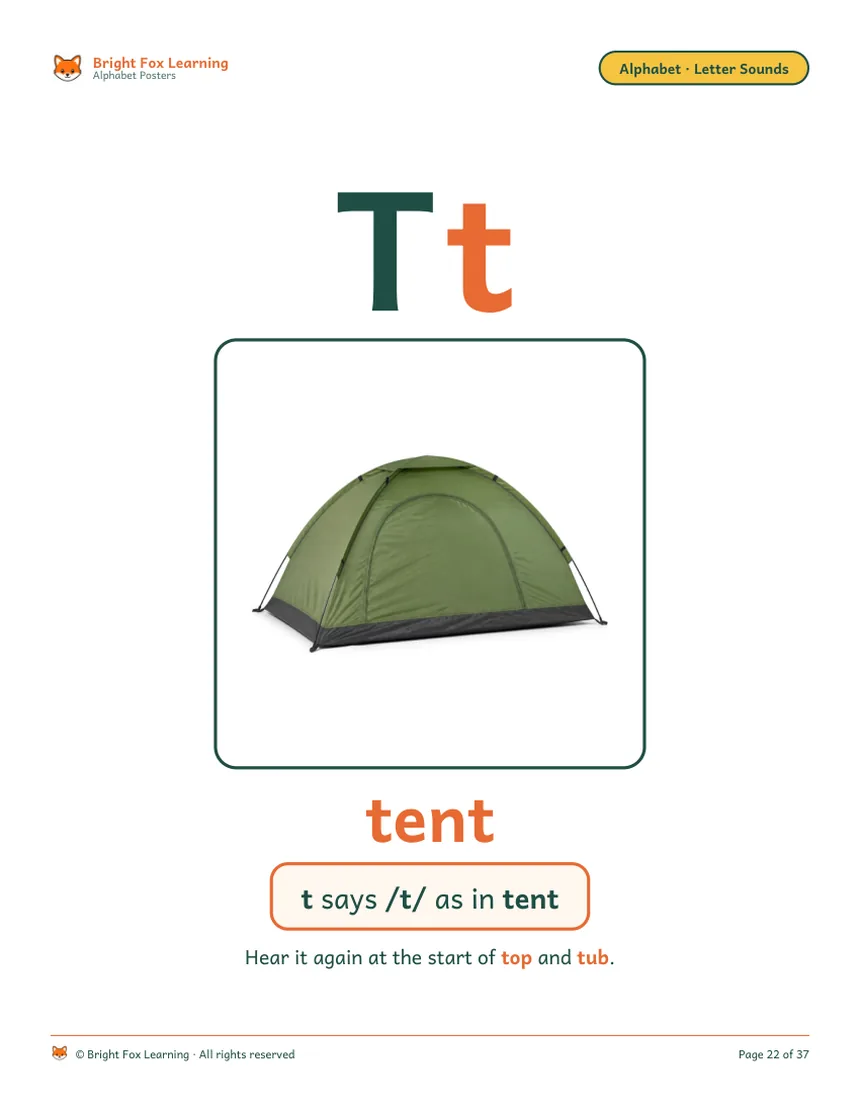
A picture on an alphabet poster is not decoration. It is the first thing a child hears when they look at the letter. Put a tree on the T and a five-year-old hears the word start with /ch/ — because that is how tree actually begins. So the tent went on the T, and every other picture got the same test.
The question that started this page
A teacher shopping for alphabet posters on TPT wrote this to a seller she almost bought from:
"I'm a little picky about a couple things when it comes to alphabet posters. What is the picture on the letter T? I don't really like when it's a tree because to the kids tree sounds like it starts with a 'ch'." — Autumn Sun, 06/20/2017
That is not fussy. It is exactly right, and it is the single most common way an alphabet poster quietly teaches the wrong thing. Tree begins with a tr blend, and the mouth-shape a child hears at the front of it is closer to /ch/ than to /t/. A child who is handed a T poster with a tree, and asked "what sound does T make?", is being set up to answer wrong — and it is not their fault, and it is not the teacher's.
So when we built F006 — Alphabet Posters with Real-Life Pictures, we did not pick pictures one at a time and hope. We wrote down the rule Autumn Sun was pointing at, and then we let it choose all twenty-six.
The rule, printed on page two so you can check it
Most poster sets never tell you why they chose what they chose. Ours prints the rule on the second page, in plain words, so a buyer can read it before deciding whether they trust the other thirty-five pages:
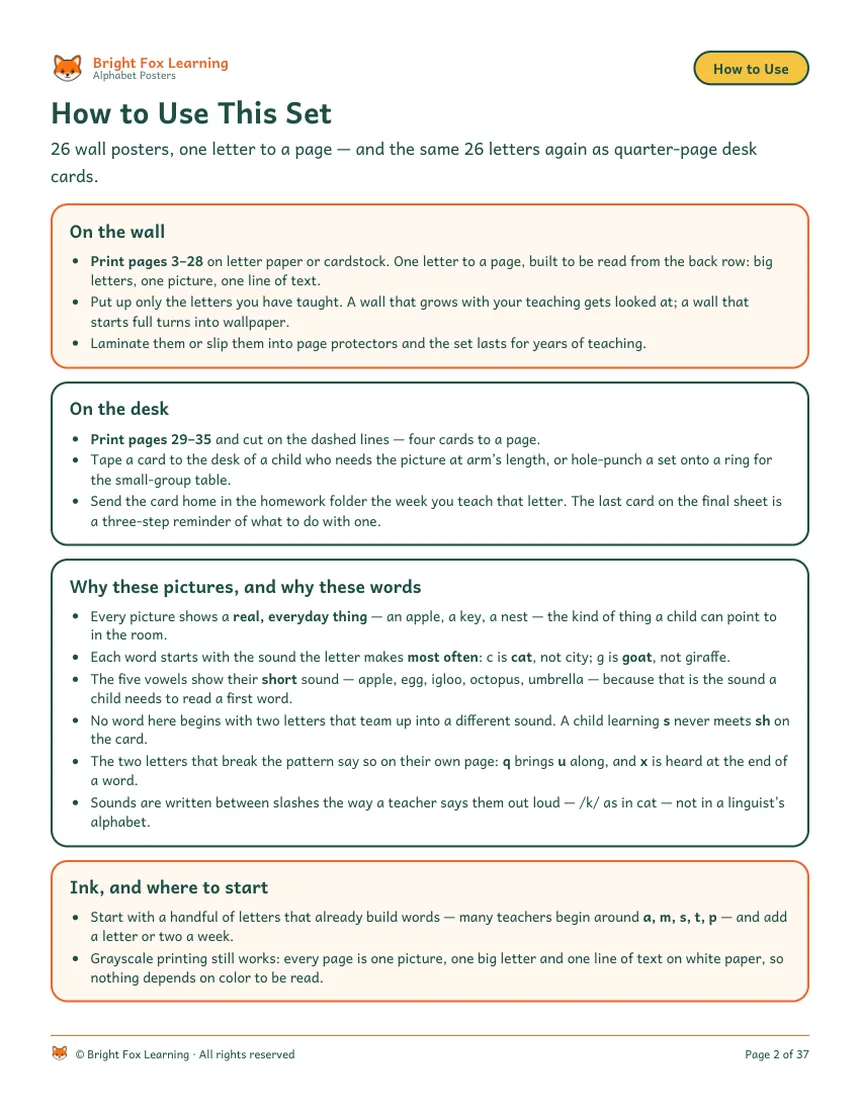
The line that answers Autumn Sun is this one: no word here begins with two letters that team up into a different sound. A child learning s never meets shoe on the card, because sh is a different sound than s. A child learning t never meets tree, because tr is a different sound than t. That single rule, applied to all twenty-six letters, is what a set either has or doesn't — and you can tell in about thirty seconds by looking at the T, the C, and the G.
The C and the G give the game away
The two fastest letters to check on any alphabet poster are C and G, because each one makes two sounds, and a careless set picks the wrong one.
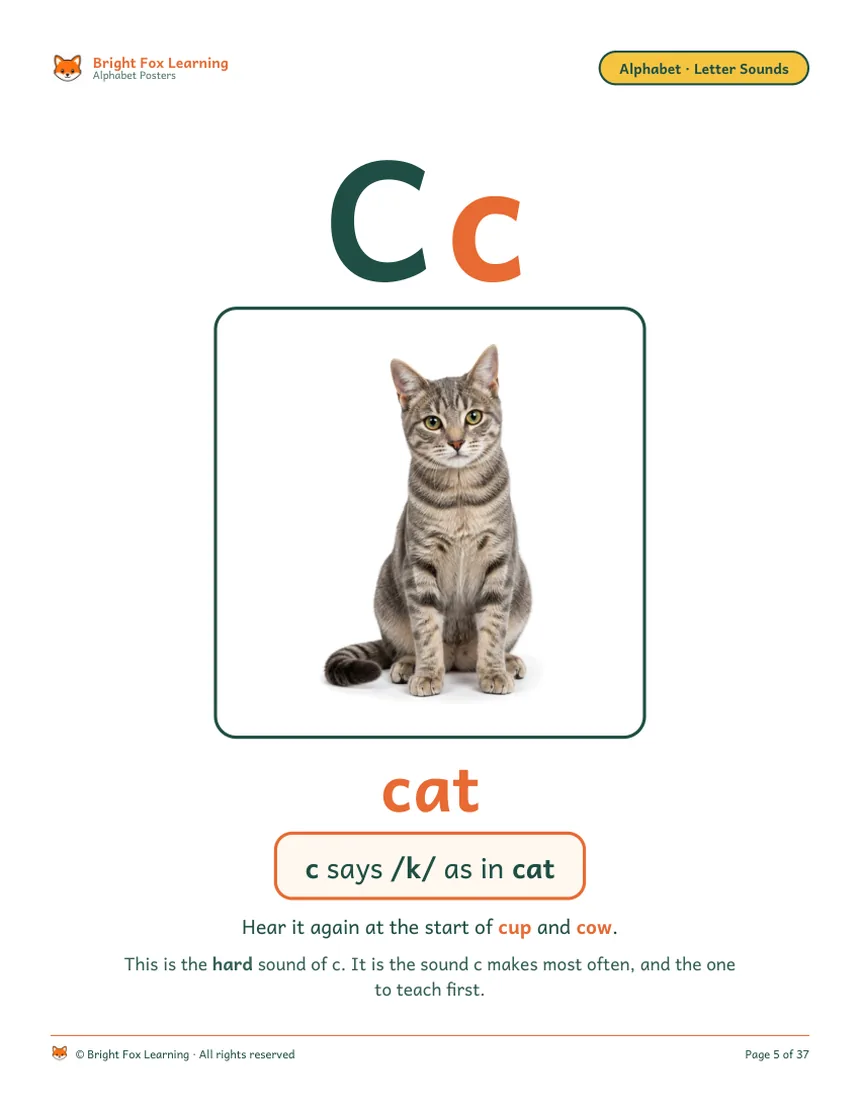
C is cat, not city. The hard /k/ is the sound C makes most often, and the one a child needs first to read a real word. A set that puts a circle or a city on the C has chosen the sound the child meets later, after they can already read — which is exactly backwards.
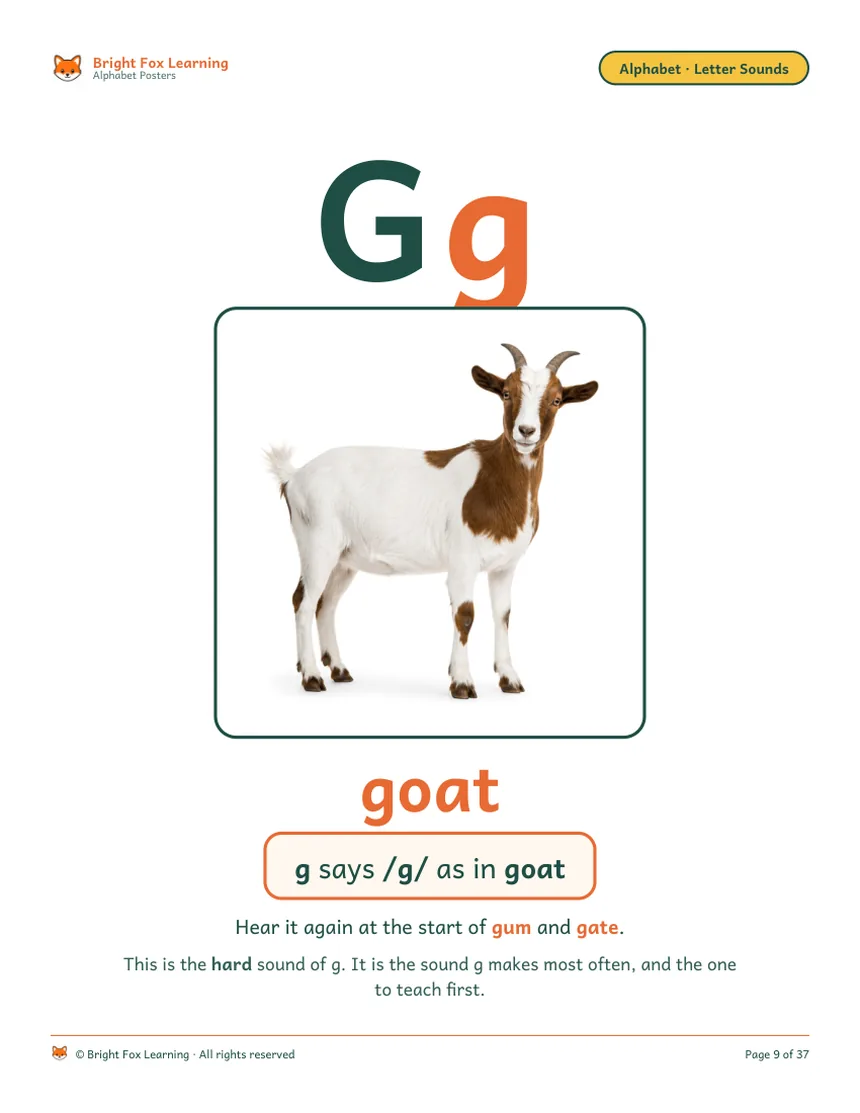
G is goat, not giraffe. Same test, same reason. Giraffe starts with the /j/ sound, which is the soft G a child meets much later. Put a giraffe on the G and the poster is teaching the exception before the rule.
The five vowels all show the short sound
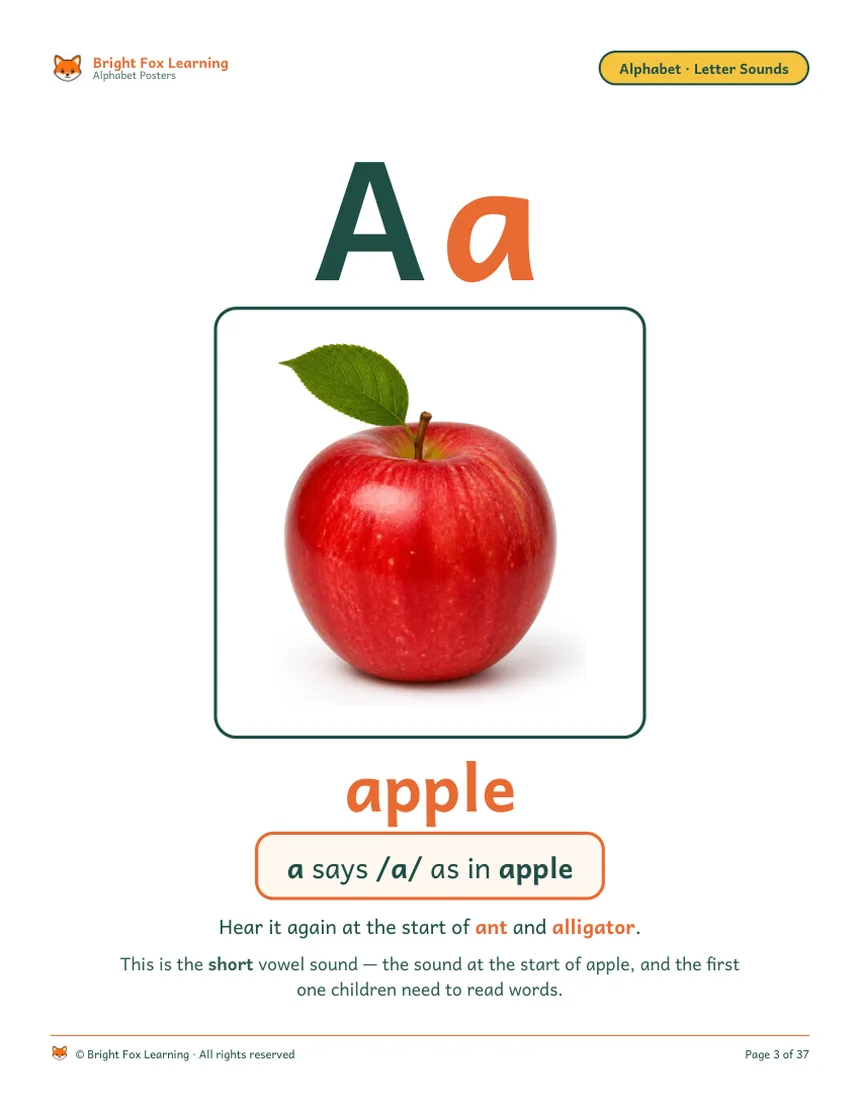
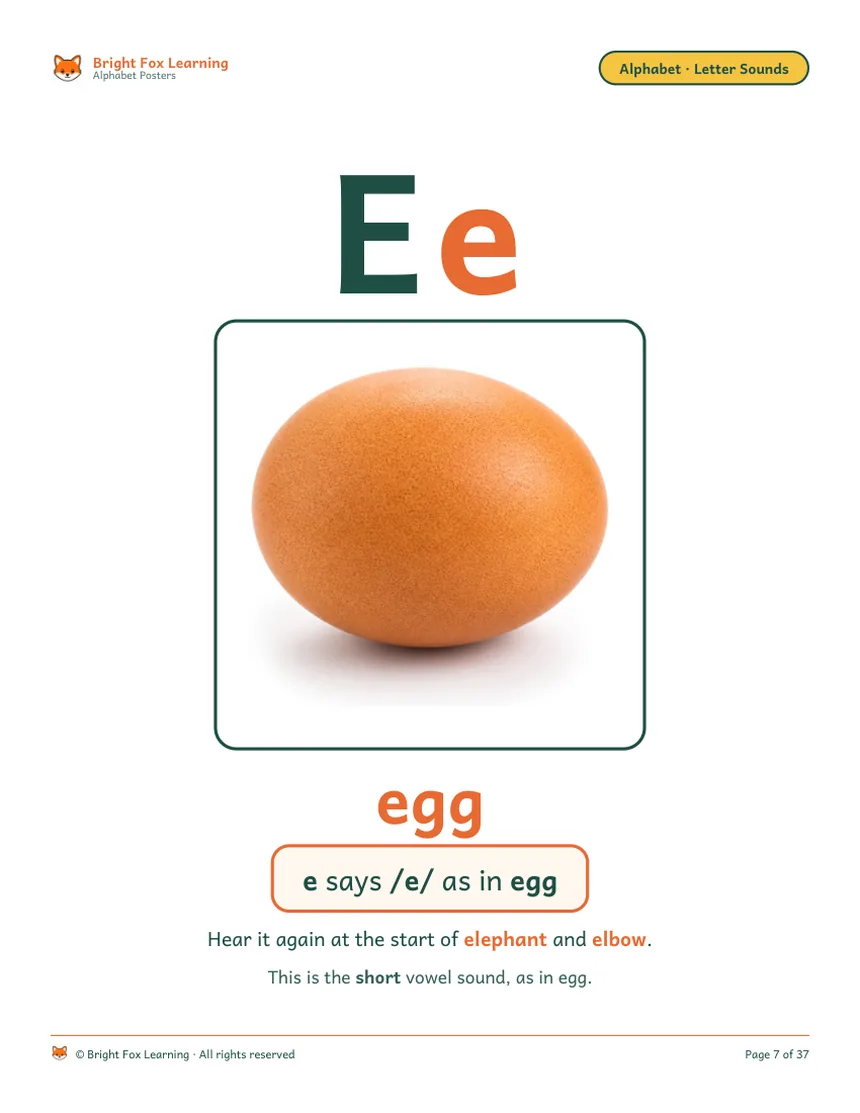
The other place a poster set quietly goes wrong is the vowels. There are two obvious choices for each vowel — the short sound (apple, /a/) or the long sound (acorn, /ay/). A child learning to read a first word needs the short one, because short vowels are what decodable words are built from. cat, pin, dog, bug — all short.
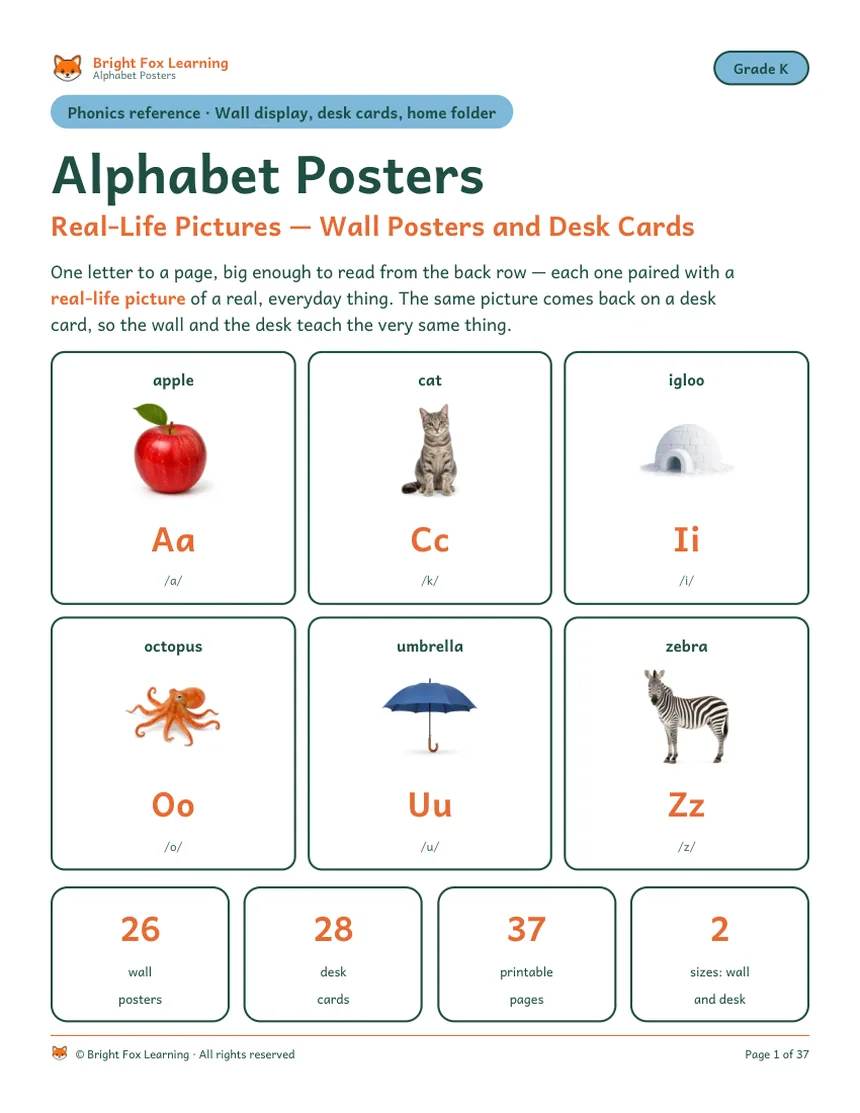
So all five vowels in this set show their short sound: apple /a/, egg /e/, igloo /i/, octopus /o/, umbrella /u/.
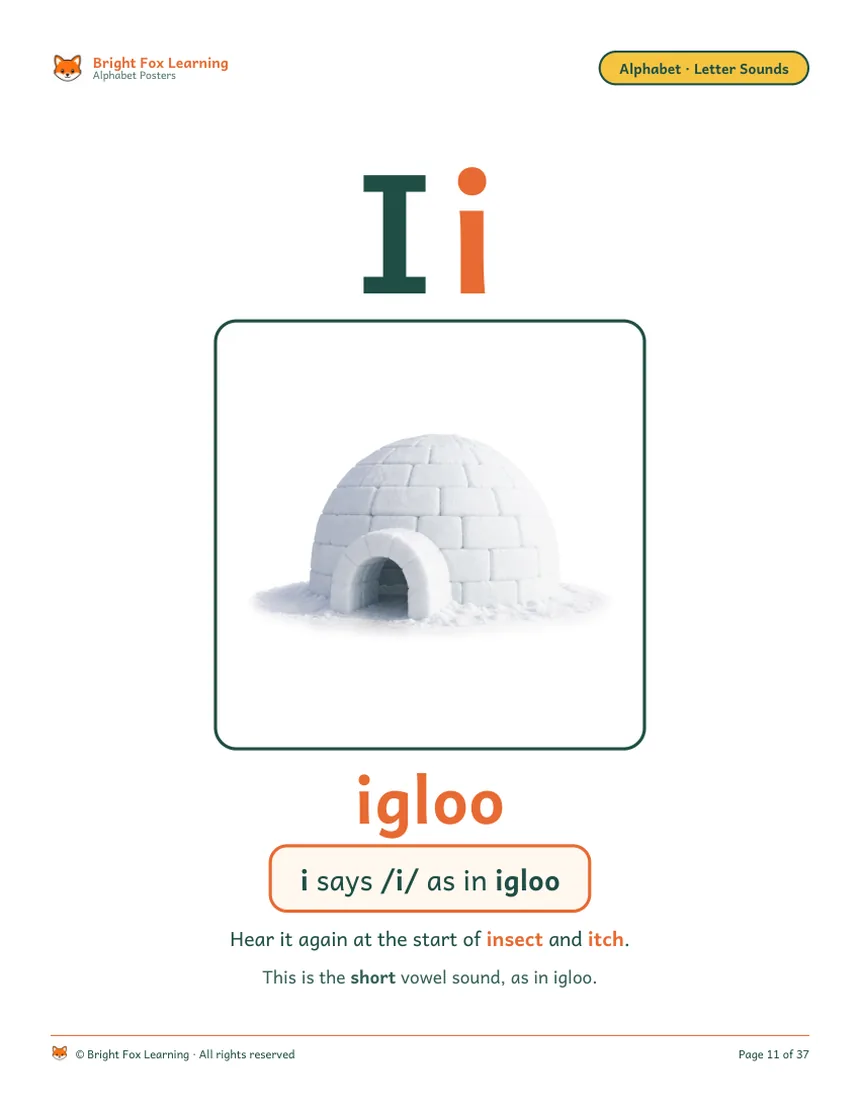
Autumn Sun's second question was about the capital I — whether it has bars across the top and bottom, or looks like a lowercase l. On the I poster the two forms sit side by side: a block capital I and a lowercase i with its dot, so a child sees both shapes for the same sound in one place. We did not add serif bars — the letters are printed in the same clean face as the rest of the alphabet, which is the shape a child will meet in their reading books.
The two letters that break the pattern say so on their own page
Two letters cannot follow the "one letter, one sound" promise honestly, and rather than fake it, the set tells the truth about them.
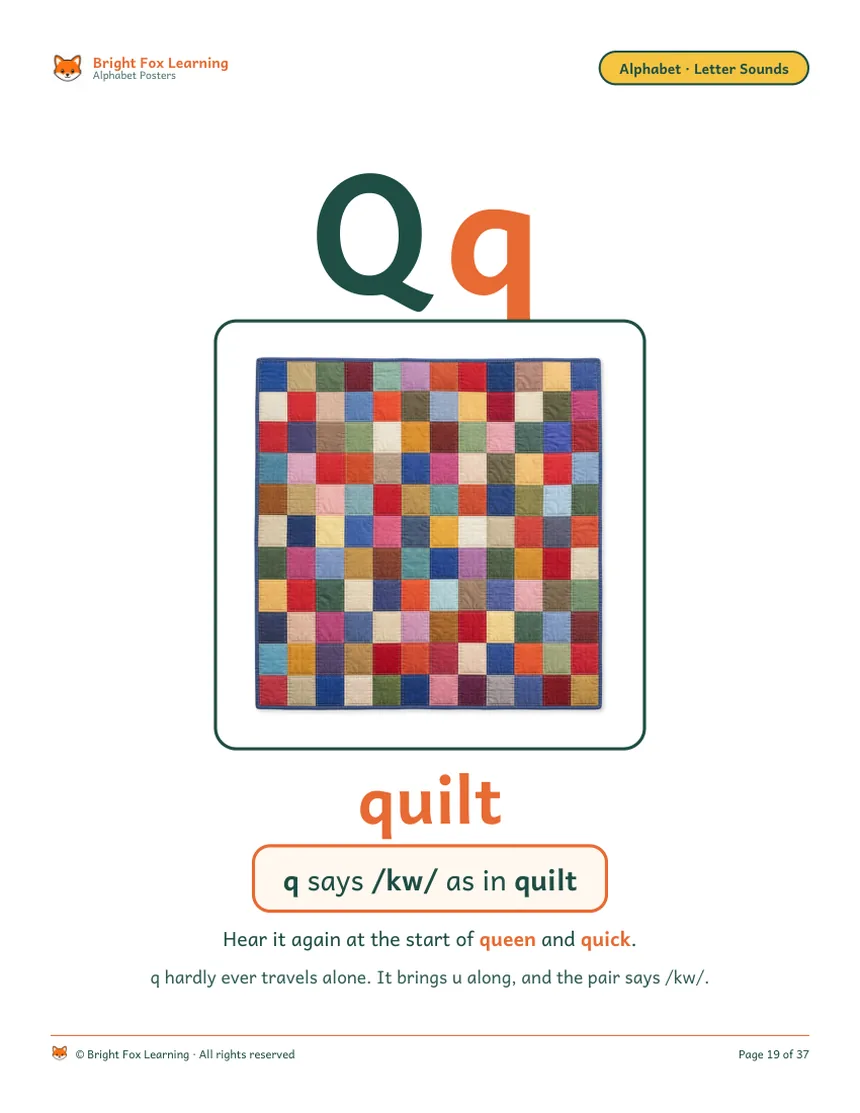
Q is quilt. The line reads: q hardly ever travels alone. It brings u along, and the pair says /kw/. That is not a picture problem — it is the honest fact about Q, and a child is better served hearing it than being handed a pretend /q/ sound that does not exist in English words.
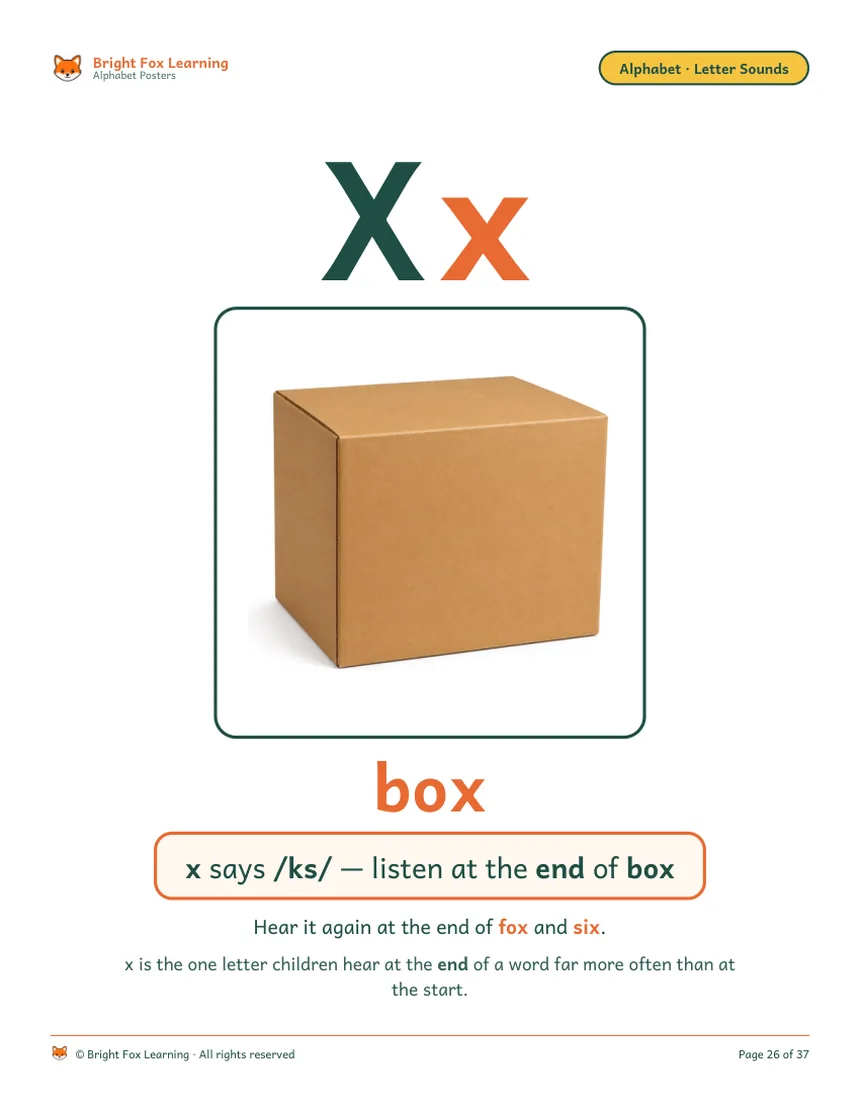
X is box — and notice the word is box, not an X-word. The line says x is the one letter children hear at the end of a word far more often than at the start. Almost no English word a five-year-old reads begins with X making its own sound; it lives at the end of box, fox, six. A poster that forces xylophone onto the X is teaching a sound the child will almost never use to read.
The wall and the desk teach the very same thing
There is one more failure mode worth naming: the poster on the wall and the flashcard on the desk showing different pictures for the same letter. A child who learns "D is for dog" on the wall and then meets "D is for duck" on a desk card has to hold two anchors for one sound.
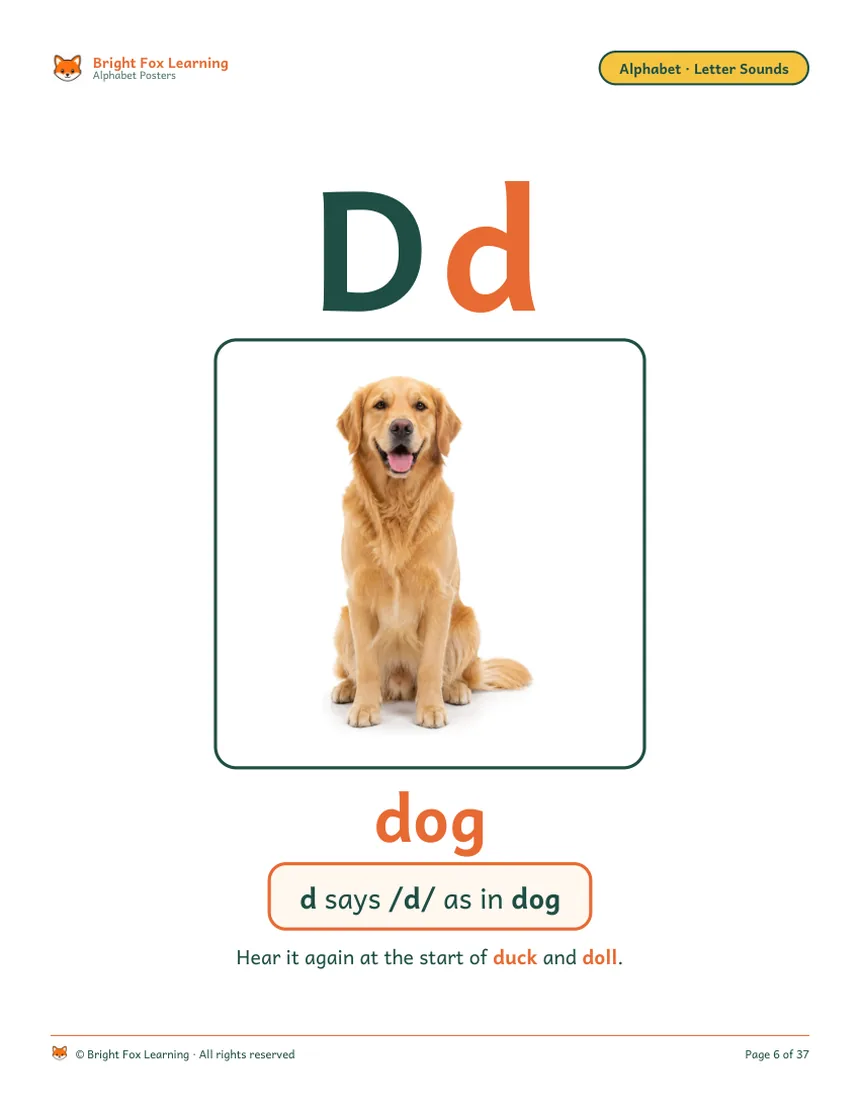
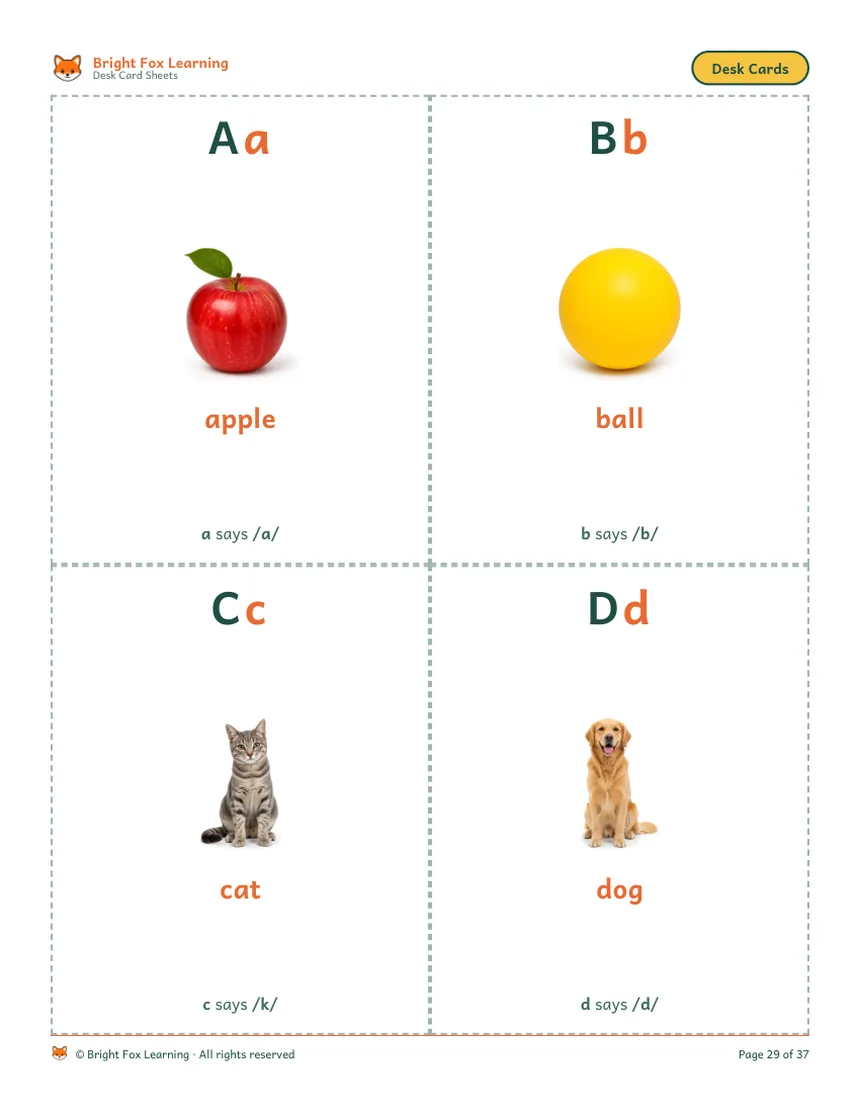
In this set the desk cards use the same photo as the wall posters, letter for letter. The wall and the desk are one anchor, not two. The same real dog is on both.
Why real photos, not clipart
Every picture in the set is a real photo of a real, everyday thing — an apple, a key, a nest — cut to white so nothing competes with the letter. This is a choice, and it costs more to make than clipart. But a child maps a sound onto the thing it actually is, and a photograph of a real dog is a dog in a way an illustrator's cartoon is a drawing of a dog. Every page is one picture, one big letter, one line of text, and it still reads in grayscale — nothing on the page depends on color to be understood.
The set behind this guide
The set that puts this rule on paper is F006 — Alphabet Posters with Real-Life Pictures: 26 wall posters, 28 matching desk cards, 37 printable pages, a real photo for every letter, and the picture rule printed on page two so you can check our work before you trust it.
See F006 — Alphabet Posters with Real-Life Pictures →
Answers to the questions we hear most
What is the picture on the letter T?
A tent — a real photo of one, on white. We chose it precisely because the common choice, tree, teaches the wrong sound: tree begins with a tr blend that a child hears as closer to /ch/, so a tree on the T sets a five-year-old up to answer wrong. Tent begins with a clean /t/.
Is the C the hard sound or the soft sound?
Hard — c is for cat, /k/. That is the sound C makes most often and the one a child needs first to read a decodable word. Soft C (as in city) is a later pattern; putting it on the poster teaches the exception before the rule. G follows the same choice: goat, not giraffe.
Do the vowels show the long or the short sound?
Short. All five — apple, egg, igloo, octopus, umbrella — show the short vowel sound, because short vowels are what a beginning reader builds first words from. If you also teach long-vowel and silent-e patterns later, those are a different lesson than the sound-the-letter-makes anchor these posters are for.
What did you use for Q and X?
Quilt for Q and box for X, and both pages say out loud why: Q brings a U along and the pair says /kw/; X is heard at the end of a word (box, fox, six) far more often than the start. We would rather print the honest fact than fake a /q/ or /x/ sound that English words do not actually use.
Do the desk cards match the wall posters?
Yes — letter for letter, the same real photo. The wall poster and the desk card are one anchor for the child, not two competing ones. There are 26 wall posters and 28 desk cards (the extra cards cover the vowel note and a how-to-use card).
Will it print in black and white?
Yes. Every page is one picture, one big letter, and one line of text on white, so nothing depends on color to be read. It costs you more paper in color, but the set was built so grayscale still works.